
Chris Kamykowski, CFA, CFP® – Managing Director of Strategy and Research
Sam Hill – Director of Fixed Income
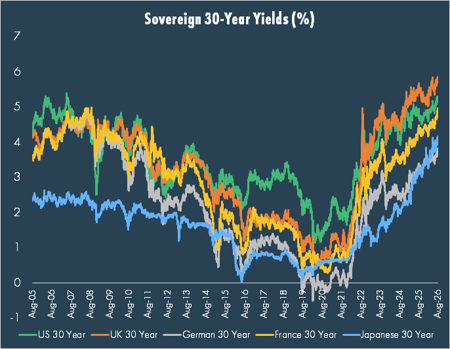
When we wrote our piece “Spending & Borrowing to Austerity: The US Fiscal Policy Challenge” in 2024, the $35 trillion national debt was already a growing concern. Today, that figure has surpassed $40 trillion, while annual deficit spending is approaching $2 trillion. The scale of the challenge has changed materially, but the underlying issue remains the same: the market is increasingly demanding evidence that US fiscal policy is sustainable. Unfortunately, up to this point, politicians of all stripes have spoken to this fiscal challenge, but actions to contain have proved harder to come by, especially with an active war to pay for and the little upside to one’s political livelihood to support real actions. For better or worse, the narrative around the US fiscal situation is not new and has floated to the top of investors’ minds regularly over the last 15+ years. It is squarely back in the headlines again with long-term Treasury yields reaching 25-year highs of 5.22%, amid signs of softer demand at Treasury auctions, prompting several articles and concern about where long rates go from here. Ultimately, today’s environment illustrates decreasing levels of flexibility on the part of the government to curtail what the collective muscle of the market and investors to force the issue with government finances.
Recap of Recent Yield Moves
Alongside the weaker auction levels noted above, yields on the US 30-Year Treasury Bond exceeded 5.30% on August 17th, levels not seen since 2007, which was right as the Global Financial Crisis was about to unfold and more than a decade+ quantitative easing. This capped a surge on long-term yields that began off the lows seen in 2020, a rise that puts the yield higher than during the inflation-induced levels of 2023. Additionally, this has not been a US situation; globally, major developed economy yields have faced upward pressure alongside the US as well, most notably in Japan, where 10-year government yields have risen to levels not seen since 1996.
Recent Actions by the US Treasury
On the heels of this, the US Treasury has been active with moves to contain domestic long-term yields.
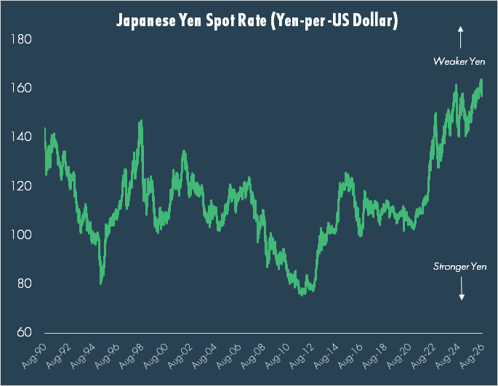
- With the Japanese Yen falling sharply to a near 40 year low in late July, Japan and the US Treasury embarked on a sizable joint intervention to support the Yen and avoid broader contagion in Asian currency markets and interest rate markets. The US specifically sold Euros from its international reserves to purchase Yen, thereby seeking to stabilize the latter. Intervention in the Yen by the US is not without precedent (2011 & 1998) but still very unusual. One market interpretation was that supporting the yen could also reduce pressure on the Japanese liquidating US Treasury holdings, thereby limiting an additional source of upward pressure on US yields. Treasury Secretary Scott Bessent subsequently highlighted the potential spillover effects of disorderly yen-market moves, lending additional weight to concerns about the interaction between Japanese currency policy and global bond markets. Recent reports also have him politely encouraging the Japanese central bank to “do the right thing” in reference to using monetary policy to defend their currency.*
- Then in mid-August, Bessent surprised the market by announcing an increase in the size of buyback operations for longer-dated, nominal coupon Treasuries, from $2B to at least $4B, starting on September 9th. Markets reacted to the unexpected nature of the announcement given Treasury had recently confirmed its buyback schedule a couple weeks earlier. As market pundits noted, the buybacks were typically utilized for market liquidity support for off-the-run Treasury securities and the impact of the increased buybacks was not expected to be meaningful . That said, it did signal awareness of and intent to contain the rise in long-term yields over the short-term.
What is Contributing to the Current Rate Dynamics in the US?
A myriad of well-tread and more recent reasons have been pushed forward as influencing the recent increase in US long-term rates or said another way, why investors are demanding more compensation to fund US’s long-term debt needs. Let’s look at some prominent ones currently being pointed to as driving factors:
- US Fiscal Trajectory
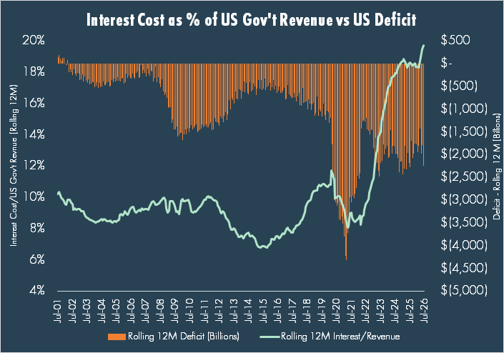
- Fiscal responsibility has not been the calling card of the US government over the last ten years, even as many a politician wax poetic about the impact on future generations. Despite a downgrade from AAA Moody’s a little over a year ago, the first ten months of fiscal year 2026 has recorded a larger deficit level in the first ten months than all of fiscal year 2025 ($1.79T vs $1.77T). This while there is no crisis to justify the increased spending. As we and many have noted, this is not sustainable as it adds to the overall interest cost expended each year as a percent of the US government budget. To support the spending needs in excess of tax and tariff revenue, the US Treasury has relied on increasing amounts of US debt onto the market at its regular auctions. But as was noted, investors signaled concern in the most recent Treasury auction with investors demanding a yield concession relative to prevailing secondary-market levels. The ever-feared “bond vigilantes” may be lurking.
- Inflation
- The Fed’s preferred measure of inflation – Personal Consumption Expenditures – remains high at 3.7% year-over-year through July, essentially showing no further progress toward their 2% target inflation level. Inflation expectations are a key component informing long-term yield levels and the longer they remain elevated, the more concerned the Fed will become. At this time, this inflation stickiness faces persistently higher oil prices as the Iran/US conflict sees no end in sight and a renewed trade war with our friends up north. Markets are taking these in stride but certainly shifting their price stability expectations and seeking more compensation as a result.
- Fed Policy
- Last week saw new Fed Chairman, Kevin Warsh, give a much anticipated speech at the Jackson Hole economic policy symposium. This came on the heels of a change in the Fed’s forward guidance protocols which the market was grappling with, leading to more volatility in interest rates. Warsh’s comments were notably hawkish as he reaffirmed the central bank’s commitment to lowering prices, and emphasized the 2% inflation target. Following the speech, market-implied expectations for a September rate hike increased from roughly 35% to 70%, as markets responded to the Chairman’s more hawkish tone.
- Hyperscaler Debt Issuance
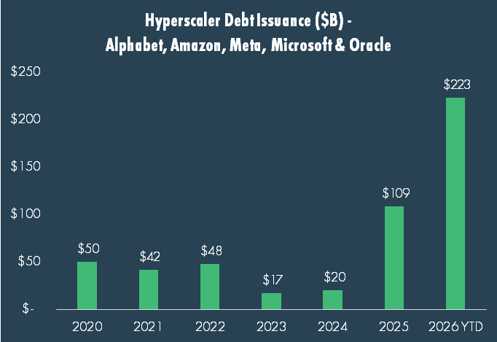
- The newer catalyst surfacing to the forefront relates to the scale and scope of ongoing and expected capex by hyperscalers. Financing these efforts will not be purely supported by their enormous cashflows; increasing amounts of debt issuance is now on the table and rapidly increasing. Why does this matter? As hyperscalers increasingly turn to debt markets to fund AI-related capital expenditures, the simultaneous increase in sovereign and corporate issuance could require higher yields to attract sufficient capital.
Conclusion
Some could say it is about time the fiscal authorities are forced to attend to their enormous borrowing and spending appetite, which has done no favors to the underlying fiscal fundamentals of the US. Many forget how long savers were subject to artificially low rates post-GFC through quantitative easing, allowing governments to borrow more and more on the cheap. While it became “normal”, and expected, for a time that rates and inflation would remain low, this was an historical aberration that would eventually need to be unwound. Today, as the market resets how it prices lending in response, the “higher for longer” fears may just be rates shifting back to an appropriate level and dare we say, normal?
Will this shift be painless? No. Markets will have to adjust expectations which, in turn, could induce volatility and valuation pressures as discount rates rise. Consumers will face higher borrowing costs that could affect spending patterns as affordability remains challenged. Corporations will need to be nimble as they manage their capital stack and capital expenditures in an effort to manage profit margins.
To be sure, this is all occurring on the back of a fairly resilient economy with steady expansion in manufacturing, an AI-related capex boom, a strong and stable labor market, and robust corporate earnings. Typically, rates do rise as the economic engine grows in strength so technically the Fed’s rate hikes should be expected given the state of the economy. Key now is keeping those higher rates from becoming more reflective of a market forcing credible action to alter the trajectory of the US fiscal situation. Hopefully, we will not have to wait for politicians of all persuasion to take this seriously only when it becomes an issue on which they can get elected. A little encouragement by the bond market may be just what is needed.
Sources
Disclosure
© 2026 Advisory services offered by Moneta Group Investment Advisors, LLC, (“MGIA”) an investment adviser registered with the Securities and Exchange Commission (“SEC”). MGIA is a wholly owned subsidiary of Moneta Group, LLC. Registration as an investment adviser does not imply a certain level of skill or training. The information contained herein is for informational purposes only, is not intended to be comprehensive or exclusive, and is based on materials deemed reliable, but the accuracy of which has not been verified. Trademarks and copyrights of materials referenced herein are the property of their respective owners. Index returns reflect total return, assuming reinvestment of dividends and interest. The returns do not reflect the effect of taxes and/or fees that an investor would incur. Examples contained herein are for illustrative purposes only based on generic assumptions. Given the dynamic nature of the subject matter and the environment in which this communication was written, the information contained herein is subject to change. This is not an offer to sell or buy securities, nor does it represent any specific recommendation. You should consult with an appropriately credentialed professional before making any financial, investment, tax or legal decision. An index is an unmanaged portfolio of specified securities and does not reflect any initial or ongoing expenses nor can it be invested in directly. Past performance is not indicative of future returns. All investments are subject to a risk of loss. Diversification and strategic asset allocation do not assure profit or protect against loss in declining markets. These materials do not take into consideration your personal circumstances, financial or otherwise.