
Episode Takeaways
What happens when the career that shaped your identity, routine, and sense of purpose comes to an end? For executives preparing to retire, sell a business, or step away from leadership, financial planning is only one part of the transition. Finding purpose in what’s next can be just as important.
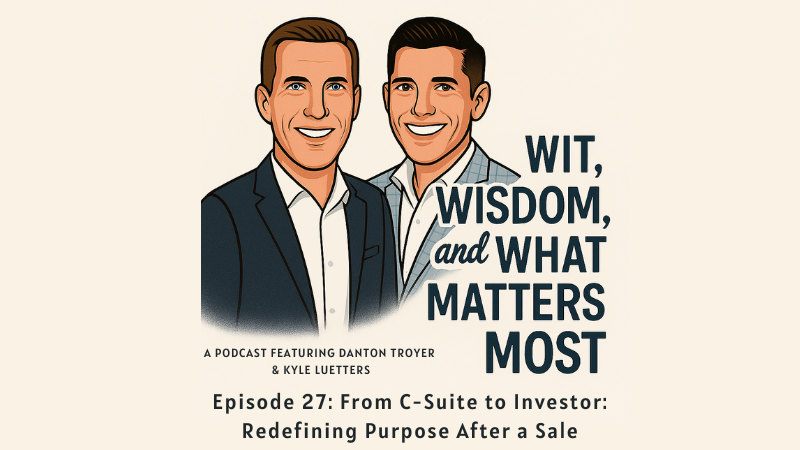
In this episode, Danton Troyer and Kyle Luetters explore what life after a leadership role can look like. They discuss why retirement and business transitions often bring unexpected emotional challenges, how identity is often closely tied to work, and why creating a thoughtful financial plan gives you the flexibility to pause before deciding what’s next. Learn why purpose, relationships, and meaningful experiences deserve just as much attention as your balance sheet when planning for the next chapter.
Key takeaways:
- How retirement and business transitions can reshape your identity, relationships, and daily purpose
- How financial planning creates the flexibility to pause before making your next major decision
- How a personal board of directors can help you prepare for life after leadership or selling a business
- How family, travel, philanthropy, and meaningful work can help build purpose after retirement
- How planning for both life’s challenges and unexpected opportunities creates greater confidence for the future
- And more!
Connect With Danton Troyer:
- Moneta Group
- LinkedIn: Danton Troyer
- dtroyer@monetagroup.com
- (314) 735-9087
Connect with Kyle Luetters:
- Moneta Group
- LinkedIn: Kyle Luetters
- kluetters@monetagroup.com
- (314) 536-8297
Transcript – Episode 27: From C-Suite to Investor: Redefining Purpose After a Sale
Intro: [00:00:00] Welcome to Wit, Wisdom, and What Matters Most with Danton Troyer and Kyle Luetters from Moneta Wealth Management. In this podcast, we help corporate executives and business leaders navigate the real-life uncertainty around new financial life stages, from complex benefits and career changes to retirement and legacy planning.
Join us as we explore these career and life-shaping moments with our guests, helping listeners find clarity so they can focus on what matters most to them
Patrice Sikora: Welcome to Wit, Wisdom, and What Matters Most. Today, Danton and Kyle tackle the transition from C-suite to investor. And gentlemen, it’s good to be with you.
Now-
Danton Troyer: Likewise, as well …
Patrice Sikora: Tell me, why is it so difficult to step away from a decision-making position?
Danton Troyer: I think there could be many reasons, but a lot of folks, especially in the C-suite, have been in their working career for a period of time, and many times they don’t see maybe this coming as quickly as it does, where there’s a [00:01:00] purchase of their firm that they’ve helped build and grow.
And so I think a lot of times there’s a build-up to it, and they do have some runway, but there’s… many times it’s not as much runway as maybe they had hoped for, and a buyer comes along, and they have to be opportunistic. And they’re going from the top of the food chain to, especially if they’re getting purchased by maybe a bigger company, they may not be in that same type of position that they once had and obviously enjoyed.
Kyle Luetters: I think an awful lot about people that have contemplated, whether it’s business owners or someone in the corporate world, as Danton mentioned, an executive, is in a position of power. And as heavy as that is from time to time with all of the decision-making that has to go on there, there is a lot of identity and purpose tied into a position like that.
And to remove oneself from that can be pretty jarring. We talk an awful lot with executives about purpose in life and what’s the meaning of [00:02:00] why I get up and do what I do, and then when that’s removed…
I like watching the TV show The West Wing, which follows a fictional president, and he really starts to, in the last season, when he’s termed out, “What do I do after this?”
And I think a lot of clients and folks that we talk to that are executives, and some business owners, they wonder what it’s like, but they’re not prepared for what it’s like when it actually does happen. And you go and you read a lot of the memoirs of a lot of presidents, it takes them a while to figure out, “I was this important, and now I’m not. So how am I useful now? What’s my next thing that I’m going to be doing?”
Patrice Sikora: In your opinion, a president is in for four years, and he gets to that point where he has a hard time leaving office. What about a CEO who’s been there for 10, 15 years? Is it tougher for them? Does it take longer?
Danton Troyer: Yeah, certainly I would say the longer they’ve been there, the more difficult it’s going to be. And maybe not the same thing, ’cause you have a little more control over it, [00:03:00] but certainly as they head into retirement, that is something that we’re discussing all the time. And maybe one of the more difficult things is transitioning from you’ve got a purpose every single day, as Kyle was mentioning, and then all of a sudden, what has been your purpose for 10, 15, maybe 30 years isn’t the same anymore. There could still be purpose, but it’s definitely not the same purpose. And so that’s why the conversation, I think, is invaluable, is just talking through what is that day-to-day life really gonna look like once the C-suite goes away.
Kyle Luetters: And to that point, that was an excellent question, Patrice, because again, if you go back to the President side of things, it’s written in the Constitution. You have two terms and you’re out. It’s written in there. So, in permanent ink, it’s written in there.
However, for an executive, a CEO, it could be a takeover to where here today, gone tomorrow. It could be a long glide path out. You just don’t know. So back to the president analogy, I think psychologically it creates a little [00:04:00] urgency because you do have some parameters of when you’re going to be out.
But for a CEO, I think someone that’s been there longer, where especially it’s out of the blue, it’s possibly a lot harder because you’re having to make this shift. You don’t get as much time to prepare for tomorrow as you would maybe in some other instances, maybe where it’s more planned out, maybe where there’s a longer runway or a glide.
And I think that’s why you see certain executives, Bob Iger at Disney comes to mind, they plan year-long transitions. So he technically has a year to think about what’s next, and part of that’s done for their successor to bring their successor up to speed. But in a way, it’s also a bone to that departing executive as well to figure out what life looks like, because you’re gonna walk in one day, and in Bob’s case, he walked in one day and he took his Disney name tag off, he put it on the desk, and he didn’t put it on the next day.
Patrice Sikora: But sometimes they come back.
Kyle Luetters: But sometimes. And Bob [00:05:00] did.
Patrice Sikora:. He did. So with the daily responsibilities, as in Bob’s case, he put his name tag down, and that was it. But the daily responsibilities, they disappear. What do you do? What do you do with yourself?
Danton Troyer: Yeah, I think that’s certainly the most difficult part for a lot of these executives. And many times, the buyout is the goal, where their compensation has been set by the board to direct them to get to the point where there can be a buyout. And you’ve worked 10, 15, maybe it was a shorter run and maybe you only had five years, but your job was basically to get this company ready for this buyout.
And you accomplished that, which hopefully is great, and you did receive the compensation. But now, that was a big drive in your life, and now all of a sudden you’re gonna just go play golf? I love to golf as much as the next guy, but it’s… And maybe it is more challenging in some ways. But I, I think the level that comes from, and hopefully golf isn’t that much stress in your life, [00:06:00] that comes from the C-suite to taking these positions, and all the people that you got to know and really took along for this ride as well and were helping, it’s all gone almost overnight.
A lot of times you can stay on as far as transition and there’s certainly opportunities maybe to serve on the board. But the reality is that day-to-day responsibility is not going to be the same probably ever. And that can be an adjustment if you don’t start thinking through that, because a lot of times that big compensation package at the end is enough to get you like a deer in headlights, but soon as that’s gone, you gotta realize there’s something, there’s, that’s it, and you’ve gotta find another way to stimulate your brain and keep your brain going. But also just fill that time that was an all day, every day, at night sometimes, and weekends and holidays – part of your life
Kyle Luetters: I agree 100% with what Danton is saying here, and that’s where not only in what we do, but also, like, career coaches, life coaches, personal boards of [00:07:00] directors. So, like, a lot of our high-powered executive level clients, they will have people in their lives, it’s like a mini accountability group. It’s like a personal board of directors. They help ask the questions of that person. Okay, so when this is done, what’s gonna be the next thing? You didn’t get here by happenstance. You’re a driven person. You have a certain level of intelligence, drive, wit, the whole nine yards to get to this place. All of that’s not gonna go away overnight.
You’re not gonna go from, or at least we don’t recommend… Like, back in the day, out in the desert, they used to test these powered sleds, which were wild when you watched them. They would shoot these people down these rails with rockets behind them, and then they expected them to stop in a certain period of time or distance. No.
That’s not what happens with executives either. Yeah. So it’s having people around you that are asking questions to figure out how you’re going to apply your God-given gifts and talents to the next thing. [00:08:00]It was a very big benefit to me to watch one of the partners on our team, working with him for a very long time before we moved here, and now watching him transition out.
He went from running a practice solely to having partners, to now exiting. And watching what he’s doing to apply the same skill, expertise, and whatnot to the next phase of his life is pretty inspiring. He’s no longer running the practice or has a hand in running the practice. He’s still taking the skills and the tools and the brain power that he has to apply it to other things.
So I think that’s one case where it’s pretty cool to watch, but I think he would be the first one to tell you that when he woke up the morning after- … kinda like the deal was done, “What do I do?”
Patrice Sikora: Yeah. So where do you find your purpose, and when should you find your purpose?
Danton Troyer: Hopefully before the deal is done…Is maybe the obvious answer. The what and how I [00:09:00] think is, is different for everybody, certainly, and age-dependent. If you’re at the end of your career and this was the cap to your career, usually about that age the grandkids get pretty exciting. We’ve seen so many folks that were so driven, and then, but you give them a grandkid, and everything changes for them.
Patrice Sikora: Yes. Oh, yeah,
Danton Troyer: I’ve seen that certainly be a game changer where that is not a problem. And we’ve seen people move across the country, across the world to be closer to their grandkids. So I think underestimating that attraction and pull after your career is maybe a little easier said than done.
And certainly, maybe if you’re earlier in your career and you happen to be part of a buyout or a sale earlier on, it’s very common for them to move on to the next deal that gets put in front of them.
And a lot of folks that are in that position, I would suggest, are probably part of several deals because that’s just how their brain works, and that excites them to be able to do that and that pressure. And so I, I think seeking that next opportunity, and usually if you’re successful at one, the [00:10:00] next one’s right there waiting for you just as easy.
So many times I think the harder part is saying no and taking the grandchild route at some point, too. And juggling that and just knowing yourself and knowing where you’re at, and really having good conversations and looking around to what is gonna be able to provide that sense of purpose because if you just turn it off, I think that could be mentally draining as well.
Kyle Luetters: I think back to a conversation we recently had with one of our clients where there was a sudden change. And objectively, he’s very good at what he does. He’s financially planned well. He started having the same questions. This came out of the blue; my world, my calculus has shifted. I don’t know what to do.
And honestly, the advice to him at that point was, “Take a breath. You don’t have to jump right into the next thing. Think about what does right now make you happy? You don’t have to worry about the paycheck immediately.” But maybe you take six months, maybe you take a year, maybe [00:11:00] you metaphorically go out into the woods alone.
Please make sure somebody has a tracker for you.
Danton Troyer: Those AirTags.
Kyle Luetters: Exactly. Put an AirTag on yourself and then go out into the woods. But get to a place, and I think for a lot of folks, Danton hit on it. We’ve seen grandkids change the calculus all the time. Best quote I ever heard on grandkids was, “If I would’ve known how great they were going to be, I would’ve been nicer to their parents.” There’s a lot of truth in that.
There’s that, but that purpose becomes either it’s family, it’s the next big thing, it is, hey, I wanna find from a philanthropic standpoint how I want to apply time, talents, and resources. We have a number of clients that end up leaving, whether of their own choice and on their own timeframe or not, really take some time, and when we’ve solved all the issues with the dollar sign, they get really involved in charities, and they get really involved in giving back to their communities in the ways and the things that they wanna do.
And if that’s going to… [00:12:00] If you live in Pennsylvania and you wanna go be a tour guide at Gettysburg, that’s awesome. But somebody has to think about that. You either jump to the next thing, you go become a babysitter – which as a parent of somewhat small children, please do that – and/or you just find some other personal pursuit that brings you a sense of satisfaction, a peace about how you’re feeling about your outlook on the world.
Patrice Sikora: It sounds to me like you’re talking about clarity of purpose and money. Now, balancing those can be a tricky thing, I’m sure. What happens when that balance isn’t there and it goes wrong?
Danton Troyer: Yeah, I think one of our guests, Deb Dubin, previously, she provides a great resource for our clients, but also, and she’s our chief philanthropy officer.
And so sitting down with her, and I’ve done it myself personally and with clients, and just asking the right questions of what can make your purpose really feel like you’re able to serve, if that’s something you’re choosing [00:13:00] to do, and finding the right organization. And it’s not always just, “I wanna work with kids. Here’s a kids organization.” And that’s true to me, but trying to find one that’s really gonna work with the time commitment you have, the resources you want to put forth, and making sure you have a good relationship. And really just asking the question, and I’ll steal from her, was, “How can I make an impact?”
And a lot of folks go in and have an idea of what they wanna do, but then if they just leave a little bit more open and ask who’s ever running the organization, they’re probably gonna have some pretty good ideas of how you can be involved, whether with, again, with time or treasure, and make the most significant impact, and that’s, I think that’s what we all really wanna do.
So to me, that was a great resource, a great conversation, is just having more thought behind it versus the typical web search of an interest of yours. But taking it maybe a step further and really exploring how you can have a meaningful impact in your community.
Kyle Luetters: I think there’s also peace and clarity behind having a plan in place from the dollar sign, [00:14:00] because that will keep things from being potentially out of whack.
If you think about it this way, one of the ways that we tee up life insurance conversations, especially for younger executives where they’ve got a lot of road ahead of them, is we’re gonna say, “Look, you’re at a certain point in your life, you need to have this so that the loved ones that you leave behind are hopefully just emotionally distraught, not financially destitute.”
So to the extent that you can use planning to take care of some of the things that would cause you some worry, would cause you to maybe make the wrong decision, if you’re constantly prepared there, and you can adapt, it allows you more time and mental and emotional bandwidth to do what Danton’s saying, which is to drill in deeper to the next thing.
We’ve mentioned grandkids, we’ve mentioned jumping into the next work thing, we’ve mentioned charity stuff. Sometimes you might also, too, just wanna go take a trip somewhere- and maybe that’s the thing. We’ve – Danton and I – met with so many people over the years that said, “I had a [00:15:00] pocket of time in my career where we could go to Europe for a month.”
And they did. They didn’t wait till the end of the plan to do it. But it was a quick conversation to figure out, “Hey, the ship just turned hard right; I’m no longer on that ship. Is it okay if I go with my spouse to Europe for a month… and just kinda think things through?” And the best conversations we get to have are, “Yes, go figure this out. Let us know how we can help.” It’s probably gonna be we send you some money to do it. But go take that trip because you know, especially for someone younger in their career, you’re gonna wanna go back to work. There’s still, I can’t necessarily say the word on a podcast, but you’ve still got enough chutzpah, maybe that might be a good word, to go out and tackle something else, but you need to take a break. And when else are you gonna get to go on a trip of a lifetime while your knees and your hips and everything like that are still in good shape? So go figure that out as well, too. So that’s where some of the financial element comes into play.
Patrice Sikora: [00:16:00] So which comes first then, the planning or the intention? Or does the intention drive the planning, vice versa? Which, in your experience, what have you seen?
Danton Troyer: Yeah,I think you figured it out already, it’s circular. We’ll do a plan and, help lead to another iteration of the plan where things have changed.
And we’re talking to clients, and this isn’t necessarily unique, but breaking down the goals and the needs, wants, and wishes. And part of that is dreaming big. So the wants are things we have to have covered, which that’s if things don’t go well, like we need to make sure that’s covered.
But the wishes are the side of the brain that we start thinking about, what if we did get this valuation, and what if there is a buy out? Yeah, I would like to buy a yacht or a car, or send the grandkids to college, or whatever – everybody’s got something that they just really wish they could do if things go maybe even better than planned. And I don’t think we talk about that enough. And things do go better than planned a lot of the time, but people just are, and [00:17:00] myself, generally pessimistic.
And when we do the plan, we are very pessimistic in it as far as our assumptions go. But the reality is, things do go well for people all the time, and if we’re not thinking about that as an option, that could be a problem because you can just all of a sudden have this great deal to get bought out and you weren’t prepared for it.
And if you weren’t prepared for it, you may say no because you just weren’t ready for it. So I think having that in your back pocket that you’ve thought through, what if something comes up that’s just unforeseen and really amazing, what am I gonna do? And so we like to have those conversations just as well because they do happen, and we should be thinking about them.
We should have something at least in reserves that, if this happens, what am I going to do, versus getting there and going, “Oh, yeah, I can’t do that; this seems too good,” because you never thought about it before.
Kyle Luetters: I will say that in my experience, the planning leads, and here’s why, I think all of us want to have a [00:18:00] decent life through the end of our time walking the earth. We can plan for that. We can figure out if nothing changes from today, if we just stay on somewhat of a linear path, what does it look like?
And if we’ve covered that home base, then I think we get into what Danton’s talking about. Holy smokes, we get this valuation, or this windfall shows up, or someone comes knocking with this offer. And then that introduces an abundance of resources into what was already a solid, well-covered-for plan. So now we get the chance to dream big.
Full disclosure, if one of those ships comes in on this end, Danton, I’m gonna train my replacement for a while, but then I’m getting out of here to go cook barbecue and do some other things.
But that’s very much, though, in that, hey, if things went above and beyond any of our wildest dreams, we still had home base covered.
Danton Troyer: Yeah. Yeah.
Kyle Luetters: And that’s where I like to go back to. I think having a general idea, because you might say no to a really [00:19:00] attractive offer if you don’t know how that attractive offer is going to affect the base. If you don’t know if the base is covered, you might not think that offer’s enough. And you might dismiss it.
Patrice Sikora: Yeah, but you do wanna dream big, don’t you? I like that idea.
Kyle Luetters: Oh, absolutely.
Danton Troyer: Kind of like when the Powerball gets up to a billion dollars, and we all start thinking.
Patrice Sikora: I’m not telling you that I bought tickets today. I’m not telling you. The Mega is 511 at this date.
Danton Troyer: That’s not too bad.
Kyle Luetters: You wanna talk about pessimism for a second.
Patrice Sikora: No, I don’t, but go ahead.
Kyle Luetters: Listen, this is the burden sometimes of what we do. Everybody else is, “I wonder what I would buy.”
And we’re sitting watching TV one night, my wife and I. And she goes, “Could you imagine what we would do with that?” My first thought was, “Oh my gosh, I’m just thinking about what the taxes would be on that.”
Patrice Sikora: You lose half of it anyway. Yeah.
Kyle Luetters: Exactly. But that’s the pessimism that Danton was talking about.
Sometimes we can’t even allow ourselves 30 seconds of [00:20:00] pure, unadulterated dreaming, like what kids do. Kids are great at this. They’re unadulteratedly positive; they have big dreams. When you get to be an adult, and you have enough life experience, it’s a cheeky way of mentioning it, but we are pessimistic, saying, “There’s no, A, there’s no way that could happen. Or B, if it actually did, all these people are gonna be up in our business. We’re gonna have to get private security. We’re gonna have to pay taxes-” And we didn’t just take the time to dream …
Patrice Sikora: and yet, Kyle, we buy the tickets. So it’s that-
Kyle Luetters: Some of us do,
Patrice Sikora: yes … that…Some of us do.
Gentlemen, is there anything we haven’t touched on today that you wanna make sure we do cover? This was a great conversation.
Danton Troyer: Yeah, I think overall it’s just preparing for the unforeseen and the foreseen outcomes that comes from being an executive and working towards those liquidity opportunities.
So we wanna make sure that folks know that it can come from the plan that you have in place, but [00:21:00] also sometimes you don’t see it coming. And but still having a plan for the stuff you don’t see coming makes sense for you.. So that way you can continue to make good decisions along the way.
Patrice Sikora: Yeah. Kyle?
Kyle Luetters: I think to what Danton just said there, the velocity at which things change in our world now is greater than it’s ever been.
And so especially if you’re an executive and you’re out there and you’re crushing it, the runways are shorter. The right and left turns are sharper, just based on, look at the disruption that’s going on in industry right now with AI, and look at what’s happened really over the last 25 years with the internet. It’s faster. The turns are sharper. So having a plan and the what-ifs is just being well prepared.
And there is going to come a point, whether by your choice or not your choice, the thing’s gonna change. The table’s gonna get flipped. So then what are you gonna do? How are you gonna adapt? How are you going to continue to move [00:22:00] forward, and how are you going to reapply the things that made you successful in the first place to possibly, or probably, something else?
And whether that’s another career, whether that’s philanthropy, whether that’s grandkids, whether it’s any number of things, how quickly are you going to adapt in an ever-changing world when you’re going to be required to adapt quicker than you’ve ever had to before?
Patrice Sikora: On that very serious note, how can people find you if they’ve got questions? And boy, I would have some questions.
Danton Troyer: Yeah, the easiest way is through our podcast. We’ll have our contact information, and our website’s witwisdomandwhatmattermost.com.
Kyle Luetters: You can also check us out, we post a lot of the shorts from this podcast as well as other different news nuggets, some anecdotes on LinkedIn and Facebook and all sorts of social channels as well.
Patrice Sikora: All right, everybody. Follow, like, share this podcast with those you think will appreciate it.
And until the next episode of Wit, Wisdom, and What Matters Most, I’m Patrice Sikora, and thanks for being with [00:23:00] us.
Outro: Thank you for listening to the Wit, Wisdom, and What Matters Most podcast. Click the follow button to be notified when new episodes become available.
Visit our website at witwisdomandwhatmattermost.com to learn more and find additional ways to connect with us in the show notes. The opinions voiced in this podcast are for general information only and are not intended to provide specific advice or recommendations for any individual. To determine which strategies or investments may be suitable for you, consult the appropriate qualified professional before making a decision.
Investment advisory services offered by Moneta Group Investment Advisors LLC, an investment advisor registered with the Securities and Exchange Commission. Registration does not imply a certain level of skill or training. The information discussed in this podcast is for informational and educational purposes only and represents the views and opinions of the guest and/or host and does not necessarily represent the views and opinions of Moneta.
You should consult with an appropriately credentialed professional before making any financial, investment, tax or legal [00:24:00] decision. Past performance is not indicative of future returns. All investments are subject to risk of loss. Please see disclosure for additional information
© 2026 Advisory services offered by Moneta Group Investment Advisors, LLC, 190 Carondelet Plaza, Suite 1200, St. Louis, MO 63105 (“MGIA”), an investment adviser registered with the Securities and Exchange Commission (“SEC”). MGIA is a wholly owned subsidiary of Moneta Group, LLC. Registration as an investment adviser does not imply a certain level of skill or training. This is an advertisement. The information contained herein is for informational purposes only, is not intended to be comprehensive or exclusive, and is based on materials deemed reliable, but the accuracy of which has not been verified. Examples contained herein are for illustrative purposes only based on generic assumptions. Given the dynamic nature of the subject matter and the environment in which this communication was written, the information contained herein is subject to change. This is not an offer to sell or buy securities, nor does it represent any specific recommendation. You should consult with an appropriately credentialed professional before making any financial, investment, tax, or legal decision. Past performance is not indicative of future returns. You cannot invest directly in an index. All investments are subject to a risk of loss. Diversification and strategic asset allocation do not assure profit or protect against loss in declining markets. These materials do not take into consideration your personal circumstances, financial or otherwise. Trademarks and copyrights of materials linked herein are the property of their respective owners.