Episode Takeaways
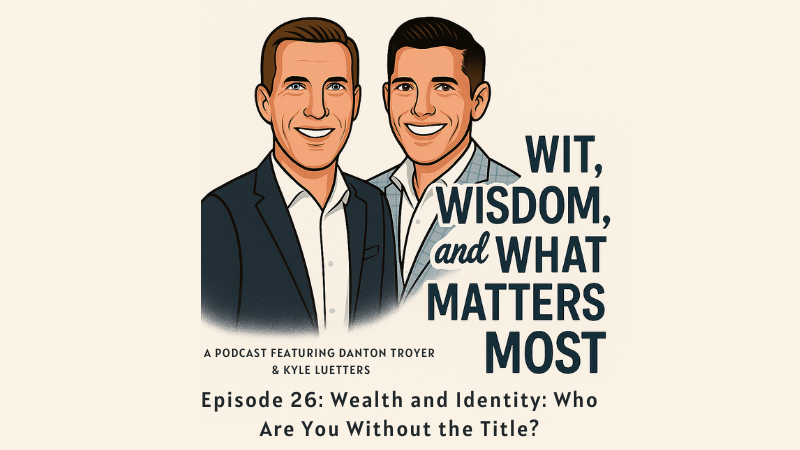
What happens when the title you’ve worked decades to earn no longer applies to you? For many executives and professionals, career transitions, retirement, AI-driven workplace changes, and unexpected life events force a deeper question: Who are you without the title?
In this episode, Danton Troyer and Kyle Luetters explore the connection between wealth, identity, and career fulfillment. Through stories of executives navigating career changes, discussions about AI’s impact on the workplace, and real-life examples of retirement decisions, they examine how titles can influence decision-making and why knowing what matters most is often more important than chasing the next promotion.
Key Takeaways:
- Why many executives tie their personal identity to their title.
- How career decisions can impact fulfillment beyond compensation.
- Why direction matters more than a rigid financial plan.
- How to navigate unexpected life changes with confidence.
- The value of having a trusted guide during major transitions.
- And more!
Connect With Danton Troyer:
- Moneta Group
- LinkedIn: Danton Troyer
- dtroyer@monetagroup.com
- (314) 735-9087
Connect with Kyle Luetters:
- Moneta Group
- LinkedIn: Kyle Luetters
- kluetters@monetagroup.com
- (314) 536-8297
Transcript – Episode 26 Wealth and Identity: Who Are You Without the Title?
[00:00:00] Intro: Welcome to Wit, Wisdom, and What Matters Most with Danton Troyer and Kyle Luetters from Moneta Wealth Management. In this podcast, we help corporate executives and business leaders navigate the real-life uncertainty around new financial life stages, from complex benefits and career changes to retirement and legacy planning.
Join us as we explore these career and life-shaping moments with our guests, helping listeners find clarity so they can focus on what matters most to them
[00:00:32] RJ Malyk: All right. Get ready for another edition of the Wit, Wisdom, and What Matters Most podcast with your hosts Danton Troyer and Kyle Luetters. I’m your podcast producer, RJ Malyk, and Danton and Kyle, as always, great to see you.
Why don’t you just give us an idea, Danton, I’ll go with you first, an idea of what we’re gonna be discussing on this edition of your podcast?
[00:00:52] Danton Troyer: Yes, certainly. Today’s topic is Wealth and identity: Who are you without the title? So, you know, we work [00:01:00] with a lot of executives and in some cases that title’s very important to them.
So we’ll talk about maybe why it is or isn’t that important.
[00:01:07] RJ Malyk: You know, that’s very interesting. You know, people get very tied into their career and I understand that to a certain extent. And, Kyle, you and I have a very similar background, and for the longest time I never thought I would be able to just not be part of radio.
Right. But I got to a certain point, and I think you can relate to this. You get to a certain point and it’s like, “You know what? I don’t need that anymore. I’ve got my own identity, and I’ve got my own way of doing things, and I’m taking ownership of my life.”
So why don’t we start with the first question. How closely is identity tied to role?
[00:01:44] Danton Troyer: Yeah, I’ve seen many folks make very bad decisions because the title wasn’t there. The role was there. Everything they wanted to do was in that position, but it wasn’t either what they expected from a title standpoint, and potentially passing up [00:02:00] great opportunity just because it wasn’t an executive position or it wasn’t the vice president of…, it wasn’t the director of…
So, you know, those titles, while we all, I think, try to say they don’t matter, uh, it matters. There’s a little ego in there when it comes to taking a new position potentially.
RJ Malyk: Sure, sure.
[00:02:18] Kyle Luetters: It really does, and sometimes, you know, we’ve talked about in the past with the juxtaposition between big companies like corporate-style companies and then smaller type companies. Like, when you’re in some of the bigger companies, I mean, couple of things – you know, pay grade is tied to certain words in your title. So, you know, if you become a senior-something or a director-something, you know there are probably bands in HR’s compensation guide that you can add a little extra coin to your bank at the end of the month.
Juxtaposition that with smaller companies, I mean, you know, you could be a vice president of the company and you’re still emptying the trash cans. Like, that’s just kinda how those things [00:03:00] go.
[00:03:00] RJ Malyk: Right.
[00:03:00] Kyle Luetters: But I do think there is a lot of identity tied around it, and I would say, especially, too, like, earlier in one’s career-
[00:03:09] RJ Malyk: Absolutely
[00:03:10] Kyle Luetters: there’s a search for, or a yearning for, legitimacy potentially, that the title helps kind of facilitate that. I’ll give a real quick example first. I’m gonna make RJ blush a little bit, but the first real job I had out of college, I worked in radio in college, but the first real job I had outside of college was I was a PR person for a racing series, and the guy prior to me was the PR Director. I was the PR Coordinator. I tried to figure out where the word director went … because that guy had it; I’m doing his job. But again, you know, being 20-something years old coming out of college, you know, you wanted to text all your buddies back and say, “I’m a director.”
So I think there is a lot of identity tied into it, and I think especially early on there is a yearning for legitimacy for that. And then, like I said too, the pay [00:04:00] grade might be tied to some of those things, and that can make or break a lot of decisions for folks.
[00:04:07] RJ Malyk: I, I think you hit it right on the head, Kyle, and I think, again, you can relate to this ’cause you and I have similar backgrounds.
The first time I was fired from my job I was 30 years old. And that was devastating.
[00:04:20] Kyle Luetters: Oh, yeah.
[00:04:21] RJ Malyk: When I was pushed out the door in a mass let go/firing, I actually was prepared for it. I was ready for it, and when my supervisor came to see me, I started laughing because I knew exactly what was going on. And I was just like, “Okay, let’s just get through this. No big deal.” I thanked him. He’s a good guy anyway, so I thanked him and stuff like that. And then it got back to me later there were other people who just lost their minds when they were let go. Yeah. And it was… He said he…
And he had to, relieve a whole bunch of people of their jobs, and he said, I was the only one. It got back to me, [00:05:00] not through him, but other people I knew. I was the only one that he was like it was a pleasant conversation.
[00:05:06] Danton Troyer: Right.
[00:05:07] RJ Malyk: So I think it all depends on where you are at with your job and how prepared you are for something catastrophic like that to happen.
[00:05:17] Danton Troyer: Yeah.
[00:05:18] RJ Malyk: You know? So for me, first time, not good. Second time, not a big deal.
[00:05:24] Kyle Luetters: And, and I think too, like, situations like RJ, what you just said right there, the firing probably caught you off guard. Like, you know, maybe some people see it coming, maybe some don’t. I think the vast majority don’t.
[00:05:36] RJ Malyk: Right.
[00:05:36] Kyle Luetters: Um, you know, we worked in an industry where there was constant consolidation. There was, like, this meat cleaver that was hanging over our heads constantly of like, “Well, who’s gonna buy us this quarter?” Right. You know? So there, there, there is a little element of that. I remember feeling that, of kind of going, “Wow, they bought 10 stations over here, and they bought 12 stations over there, and now we can…” Ooh, I remember the [00:06:00] big thing is when you could voice track and have a personality in one market do another one. And-
[00:06:09] RJ Malyk: Oh yeah, I did it. Yeah
[00:06:10] Kyle Luetters: Same. And so general managers are like, “Wow, we could, you know, pay a talent a fraction of the cost.”
[00:06:14] RJ Malyk: I was… at one point I was on three different stations in the same market at the same time.
[00:06:21] Kyle Luetters: Same.
[00:06:21] RJ Malyk: Yes.
[00:06:22] Kyle Luetters: Yes. And yeah. And I remember that, and I remember I kept thinking, “You know, this is a pretty good gravy train, but I’m not making three times…”
[00:06:29] RJ Malyk: No …
[00:06:30] Kyle Luetters: the income.”
[00:06:31] RJ Malyk: No.
[00:06:31] Kyle Luetters: I’m basically getting some kibble off to the side to do these other two while I handle the big one.
RJ Malyk: It’s crazy.
Kyle Luetters: You know, so taking it back to title, it’s like, you know, your title was still the same. It was just in order to stay here and keep doing this, and sometimes that’s what it’s about with some of these titles. In some industries, as things evolve and change, you keep your title, but what you signed up for under that title is not the same thing. So if you have your identity tied up into that, that will really start to mess with your head a little bit. It 100% [00:07:00] will.
[00:07:00] RJ Malyk: I see that happening, potentially happening in a bad way with AI coming in and people’s titles changing. Danton, what do you think?
[00:07:09] Danton Troyer: Yeah. Certainly, I mean, there’s gonna be a consolidation of talent and just duties.
I think in general we all will be expected to do much more. And whether you get a title or a pay increase because of that is probably not very likely. I mean, it’s just gonna be the expectation. There might be a little bit for a while, but, I mean, even within our own team here, you know, it’s like, “Is my job safe?”
“It’s like, well, yes, you’re here. We’re not… I don’t see layoffs coming because of this. But to think that you’re gonna be doing the same job in the same way, is probably not very likely.” I mean we talk about our client service managers working with the clients here, and they’re probably gonna be able to do way more in just a very short period of time.
And, you know, for me, that’s exciting and… but that can also be a little scary thinking, “Oh, my gosh, how is this gonna… You want me to do how much more?” And, you know, I guess the short answer is we don’t know, [00:08:00] but it seems like it’ll trend that direction for sure.
[00:08:02] RJ Malyk: I think you also have to look ahead and see now, how do I position myself with everything changing?
I think we’re gonna see… and we have. We’ve seen a lot of changes since, let’s just say the last 20 years. I mean, compared to the prior 50 years.
[00:08:20] Danton Troyer: Oh, gosh.
[00:08:20] RJ Malyk: I mean, I think the changes were just incredible, and the amount of changes were just incredible, and I think it’s just gonna increase as we go along.
So how do you… I mean, I guess the best advice you can give to clients is “get yourself prepared for change.”
[00:08:36] Danton Troyer: Right, and I think especially at the executive level, I was talking with a CEO of a pharma company the other day. And to think that… I mean, the goal is to change and try to get better, so I mean, that is what we’re trying to do. And to think that AI can’t accelerate that in a positive way, I think is best…
I mean, we said the same thing when the internet came out. And, you know, I remember, even coming to Moneta and we introduced [00:09:00] some new technology, and people were at first, were a little hesitant. But now we look back and it’s like, “Why weren’t we doing this, you know, sooner?”
So it certainly makes you more productive. It’s always scary as you’re entering into that because anything new is going to be that way. But anybody who’s been in business or just alive for a period of time has experienced a decent amount of change. So I don’t think that is necessarily going to change, but how rapid that is, seems like it’s going to take off here very shortly.
[00:09:31] Kyle Luetters: I like using the word iterations because that’s a very technical term. Like, you’ll see, different apps and want the iteration of this, iteration of this. Let’s be frank here. Our roles will continue to be to guide people and give them sound wisdom and advice to take care of what matters most to them so that they can do that.
The modecom, the way that we do that’s gonna change, much like, you know, RJ, we talk about the radio industry, the same way that [00:10:00] Ford does not build F-150s the same way they did 20 or 30 years ago.
[00:10:05] RJ Malyk: Sure.
[00:10:05] Kyle Luetters: They’re still pumping them out, still best-selling vehicle in the world. That is not a plug for any sort of investment; please do not hold me to that. But, you know, we still see F-150s rolling down the street, but Ford doesn’t build them the same way that they did 30 years ago. They evolve and change with the times.
And to the extent that businesses and/or folks don’t evolve… By the way, the titles at the factories too, they’re probably not the same.
[00:10:31] RJ Malyk: Right.
[00:10:32] Kyle Luetters: They are probably not the same anymore because there’s way more automation, there’s way more tech. And so if you don’t change, you kind of die. You become a dinosaur. I mean, we can go through and look at the graveyard of automakers that did not iterate, that did not keep up with things.
And I mean, I really liked me some old Pontiacs, but- Ah … it’s just not around anymore.
[00:10:52] RJ Malyk: I was thinking the same thing. You and I are on the same- Oh, man … same wavelength. Pontiacs, my dad had a Pontiac,
[00:10:59] Kyle Luetters: Right. [00:11:00]
[00:11:00] RJ Malyk: And I thought it was a cool-looking car. Yeah.
Danton Troyer: Those Grand-ams, man
[00:11:03] Kyle Luetters: yes. Was that not for a period of time, like we always talk about the high school kid car.
[00:11:08] RJ Malyk: Yes.
[00:11:09] Kyle Luetters: Was the Pontiac Grand Am with the boat-long doors.
[00:11:13] RJ Malyk: Right.
[00:11:14] Kyle Luetters: My go- And the track pack. Oh, stop,
[00:11:18] RJ Malyk: So when you’re talking with clients, and how do you approach, or I mean, and I’m sure it’s a different approach to people at different stages of their career.
But change is happening, as we alluded to earlier. How do you approach this with your clients? You know, change is coming. where change will constantly be happening, how do you prepare them for the change? Or is that not something you try to do?
[00:11:46] Danton Troyer: I would say that’s one of the biggest things we do is helping folks when there is a Y in the road.
And so, whether that’s a simple, maybe not so simple title change, talking through what that actually means to you beyond the [00:12:00] title. You know, talking with clients maybe to your point, go from like a vice president role, and then they’re offered a CEO role, and that sounds great.
I mean, if I stop the story there, you’re like, “Yeah, let’s do that.” But if you stop and take a step back and say, “Okay, well, what does this mean?” You know, the money’s better, hopefully, but maybe if you’re moving to a smaller company, it might not be. We had to evaluate one, the salary was about the same. It actually wasn’t that much more, but the equity compensation was through the roof, but that’s a lot of risk. And at what point in your career are you willing to take that risk? And at what point of your career are you just like, “I could take what I got, and I could ride off into the sunset in five years. This may set me back five years.” Is that worth it?
Not to mention, you have to move your family across the country, by the way, too. So to think that the title is important to some people, but if you start to peel back that onion, it’s just, there’s so much more to it, and it may not be the best choice to take that position with that risk if you don’t have the appetite for it [00:13:00] potentially.
[00:13:01] Kyle Luetters: You know, we kind of talked about some of the monetary side of things here, but too, if you go from like a senior director level at a larger company where there’s a lot of backfill and there’s a lot of this and that, and you’ve got a pretty good setup as far as family time, and if that’s really important to you, or let’s say you like being out on your boat.
You go become a CEO, which on paper sounds great, but maybe you go become a CEO of a smaller company, you’re maybe missing some kids’ ballgames, and we’re not on the boat as much. And, you know, sure, the money’s great and the equity comp’s awesome, but part of what we walk people through, because we’ve seen it a number of times, is this idea of we know our clients very well.
We know what matters most to them. We know what makes them tick usually. And so we’re actually a pretty honest sounding board of saying, “Look, I know you’re real excited about this. I know that they’re gonna put three flashy letters behind your name, but is this really what you want? I mean- dollar signs and [00:14:00] everything like that withstanding, do you really want this? Are you really ready to saddle up for the challenge?”
[00:14:05] Danton Troyer: And, I mean, I actually had a client that had the opposite problem almost in that he was actually in between jobs and was let go by the board, of a CEO position. And, you know, he was used to being the CEO, making good money, and he got offered a job, I think it…I don’t remember, it’s been probably 10, 15 years ago, but it was like a director level, and the salary wasn’t very attractive. But we stopped and talked about it, and, ’cause he was really just telling me kinda off the cuff, like, “I turned this one down.” And I said, “But you told me you wanna retire in five years.
I mean, does it really make sense to go back as a CEO for five years at a company?” And he kinda said…that immediately took him back a minute. And then I said, “The money, you don’t need the money. You could retire tomorrow and you’d be fine.” And he sat back again. And then I asked him, I said, “And this position is like, didn’t you say you wanna retire in – it was a different state – and it’s actually really close to where your cabin [00:15:00] is that you wanna retire at, right?”
And he’s like, “Well, yeah.” And I go, “And you told me you need some time to fix this cabin up, right?” And he’s like, “Yeah.” And you could see him starting to get the point and starting to see that this position is actually exactly what he needed and wanted. It gave him a position where he could still continue to contribute to the workforce and he still had great ideas, and that was the big thing for him is he wanted to continue to contribute. So he was able to move up there with his wife, continue to work, fix up the cabin that they planned to retire on, and, and, and like, it was a perfect setup for him. And the, the sad part of the story is he actually passed away before he got to fully retire.
Oh,
[00:15:37] Kyle Luetters: enjoy it. Yeah. Geez.
[00:15:39] Danton Troyer: The good, the good part of the story is, though, his wife is still in that cabin doing her gardening, and I don’t know that she could’ve got to that place if he didn’t make that decision. And so what started off as a conversation of just him just telling me a job he had passed on turned into what changed his wife’s life in, I think, a very tremendous way that wouldn’t have happened.
And not to say [00:16:00] that I was the one, but it was just having someone to talk through those conversations with.
[00:16:04] RJ Malyk: Right.
[00:16:05] Danton Troyer: That’s what it’s about
[00:16:07] RJ Malyk: Mm-hmm. Well, that, I mean, that’s your position- Yeah … is to talk to people about different possibilities that, you know, you can go through. And when you’re younger, you’re not thinking of things.
And, and my wife and I, in the last five years, have gone through, separately, health issues that came out of the blue. And we were fortunately, we are in a pretty good position to be able to weather both issues. Mine was almost five years ago. Hers was just recently. And, again, our financial advisor, he was with us every step of the way and was able to guide us and help us, and we were able to get through it without any issues.
So I guess what I’m trying to say, planning is just so important, and to have a plan, because you can never predict the future.
Danton Troyer: No.
RJ Malyk: Like I said, mine came out of the blue. My situation came out of [00:17:00] the blue, and my wife’s situation, just, you know, one day everything is fine, the next day it’s like, “Oh my God, what are we doing?”
[00:17:06] Danton Troyer: Yeah.
[00:17:06] RJ Malyk: So, and it’s hard to plan for that, but if you have a general plan… I mean, I guess I should ask you, how do you talk to your clients about planning for worst case scenarios?
[00:17:18] Danton Troyer: Yeah, I think just in general, like you say, like having a plan, it’s something to anchor back to. And we talk about this all the time.
There needs to be flexibility in this planning, but if you don’t have something to step back and say, “What was important to us?” in any given moment, you can get distracted very easily, and that goes with health concerns or something else. I mean, it’s not always… I mean, sometimes we always think, oh, it’s a nice shiny thing that’s distracting us, but that’s not always the case.
It can be something that’s kind of negative and not even in your control, like a health concern. I mean, my wife similarly had a health concern, and it kind of set us back for a minute.
[00:17:52] RJ Malyk: Sure.
[00:17:53] Danton Troyer: But being able to say, you know, “These are the things that were important to us from the beginning,” and it just helps you really make those decisions of how to [00:18:00] move forward.
Even if it wasn’t the way you planned to move forward, you still are moving toward that direction that made sense to you to start with. So it doesn’t necessarily hopefully derail the plan completely, but if it does, it’s bringing you back to what was really important to start with. And you can still make strides toward those things, it’s just maybe not in the way you thought it was.
[00:18:13] Kyle Luetters: There was a word Danton just used there that has been popping up quite a bit lately. There’s a podcast I listen to each morning, first thing in the morning. It’s called The Daily Blade. And the pastor that goes onto the show and records these little five-minute snippets, this week was talking about instead of having a plan or vision, do you have direction? Do you have a general vicinity of where you want to be, what you want to achieve, and more importantly, who you want to be known for, what you want to be known for?
And so many times with our clients, like, we’ll tell them, like, it’s not like, “Hey, here’s your financial plan. Here it is on a platter,” and just, like, accept it as gospel- and turn the page every year and this is gonna lay out exactly the way that we said, including the return numbers, by the way. ‘Cause we got beat up on [00:19:00] that.
[00:19:00] Danton Troyer: We don’t even print them anymore because they change so often
[00:19:02] Kyle Luetters: I remember when I first got in this industry nine years ago, we printed out one of those plans. It was, by the way, 100-plus pages.
[00:19:11] RJ Malyk: Wow.
[00:19:12] Kyle Luetters: Bound it and gave it to the person. I made the joke to them, and I don’t think they appreciated it, and I said, “Hey, by tomorrow based on what the markets do, that’s all wrong.”
Danton Troyer: Yeah.
[00:19:20] RJ Malyk: Oh, wow.
[00:19:21] Kyle Luetters:. ‘Cause if you think about that-
[00:19:23] RJ Malyk: Yeah …
[00:19:24] Kyle Luetters: any of those projections are just that. They’re a projection based on the data set at the time you made the projection.
[00:19:30] RJ Malyk: Sure.
[00:19:31] Kyle Luetters: Same thing with any one of your plans. Like, for crying out loud, we have monkeyed with the tax laws in this country more in the last 10 years than we did the prior 80 years. Somebody’ll fact-check me on that, send the email to Danton, it’s okay.
But the point of it is the moment that we put something pen to paper in a plan, it’s probably going to be out-dated within 12 months just because that’s the way the world changes. So direction now is [00:20:00] becoming more and more of a thing that I am using in conversations with clients, with executives, with families, of saying, “What direction do you want us going in? What direction, when you get to the end of your life, do you… if the sky is completely open, kind of like point out a certain way, and which way do we want to end up there?”
Because I think the plan and the mode to get there is gonna change because the tools are gonna change, the circumstances are gonna change.
[00:20:28] Danton Troyer: Yeah.
[00:20:29] Kyle Luetters: And then if they get really upset and they just said, “Look, you know, I really want a plan for everything,” I’ll say, “Okay, the best thing you can do is get a cabin, bullets, and become a really good shot. Live off the grid. Because then you’re taking away a lot of the variables that are a part of this thing. You’re putting more on your shoulders, dude.”
[00:20:44] RJ Malyk: So I guess it’s safe to say that you should really get together with your financial planner at least once a year to review where you’re at, what’s going on in your life, and what your goals are, because goals will change due to [00:21:00] certain factors in your life.
So once or twice a year, once a quarter? I mean, what do you think, or does it all depend on a person’s individual situation?
[00:21:09] Danton Troyer: Yeah, certainly that’s the key. Especially if you’re going through something, you’re probably gonna need a few more conversations. And obviously we’re a little biased and we always think a financial planner is a good person to have on your team.
But to be – you just need somebody that you can go to and get solid advice, that knows you well. I think the biggest mistake we see people do is they go to, I don’t know, say like an uncle or, you know, someone at work, and then you’re asking for- The
[00:21:33] Kyle Luetters: brother-in-law at the holidays … yeah.
[00:21:35] Danton Troyer: Maybe you’re really close with your brother-in-law, maybe that is the right person, but it’s probably not, too. Because, I mean, generally we’re seeing these folks, they see you once a year at Christmas and then, but they have the best plan for you. And it’s like, no, no, they don’t.
They don’t know the things that you’re really trying to accomplish. You have surface-level conversations. And to be fair, there’s advisors that maybe are having that surface level conversation. “You [00:22:00] wanna retire at 65, and you need 80% of your income,” and that’s the end of the conversation.
So it’s not always a financial advisor that’s always the best person even to be equipped with that, but someone you can go a little deeper with and really can have these good conversations beyond the surface level of “What’s your goal in life?” And then that’s it. So there needs to be some follow-up questions.
But to your point, having those conversations on an ongoing basis I think, is just monumental, and it can be very helpful for you just mentally to have that plan and someone to go to to have these conversations with. Otherwise, you’re just doing it in your head and kind of reaffirming what you already think and know.
‘Cause you know, that client in the story I gave earlier, if he was just having that conversation with himself or his brother-in-law at Thanksgiving, he wouldn’t be where…that wouldn’t have happened the way it happened, so.
[00:22:50] RJ Malyk: Sure.
[00:22:50] Kyle Luetters: Yeah, I’ll tie this back to some conversations about AI and making us far more productive.
You know, we all have these (smart phone), and we now have secure [00:23:00] texting because we have to be above board with all this stuff. Clients, I, I think there’s a wall that’s coming down a little bit, especially in our industry, to where it used to be we would…
When I started in this business, we had clients that would come up here from Florida. They would come see us. They would go see their CPA the next day. They’d go see their attorney the third day. They’d go see the insurance guy on the fourth day, and then on the fifth day, they had lunch and went home And that was it.
But now with technology and the speed at which things change in our lives…
Two stories here real quick recently.
Wonderful couple, about my age. They do very well. They’ve been on the fence about moving. “We shouldn’t upgrade our house and our house is fine or this and that.” I get a secure text, I’m making sure Danton hears that it was a secure- … text on Friday evening with a listing that was a gorgeous house right on the river over here, everything they ever wanted, and underneath of it, it said, “Hey, contract accepted. Can we talk?”
The [00:24:00] other one, “Hey, we’re pregnant. We just found out that there’s gonna be some complications when they’re born. What do we do with this, this, and this as far as the benefits go?”
[00:24:10] RJ Malyk: Sure, sure.
[00:24:11] Kyle Luetters: Those are conversations that can’t wait one year or every quarter or this or that, but they reached out in both instances. They reached out because of the way that we have worked with them and positioned ourselves as someone that’s better than the brother-in-law at Thanksgiving.
[00:24:30] Danton Troyer: Yeah.
[00:24:30] RJ Malyk: Uh, uh, okay, so I was gonna say, the reason that happened is because you have multiple conversations with them throughout the year. You stay in touch with your financial advisor, so your financial advisor has a good idea where you’re at.
Instead of throwing it on their lap saying, “Okay, here’s everything, now fix it- by tomorrow.”
[00:24:53] Kyle Luetters: Exactly. Now, that still does happen.
Danton Troyer: I was going to say, I had that call this morning, but…
Kyle Luetters: That does happen particularly on, like, April 14th a lot… and December 30th. [00:25:00] Those are two big ones. If you’re a business owner, September 14th-ish
[00:25:04] RJ Malyk: Okay
[00:25:04] Kyle Luetters: But they still do, but I think going back to what you guys were talking about titles to us, like, yeah, we’re financial planners, financial advisor, whatever you want to call- trusted guides. I mean, there’s a litany of things that from a marketing standpoint we’ve tried to call ourselves. Trust me, Danton and I have gone through the rigamarole on trying to figure this out.
The title doesn’t matter as much. To tie all this back to the very beginning of this episode, it’s what we do and the role that we step into for these folks and these families and these executives’ lives. It’s more about what we do.
Right now, you know what my title is? Advisor. You could take that a lot of different ways. But that’s what I’m doing. And it can be advising on a litany of things. If I got real directive with it, I could reasonably raise my hand and say, “Nah, that’s just not my wheelhouse. I advise on this, and you need advice on that.”
It’s what you’re known for, and I think when we have clients like executives and [00:26:00] whatnot, when they get to a point where they stop chasing the title and they’re more chasing the work-
RJ Malyk: Right
Kyle Luetters: … and the fulfillment from the work, that’s a part of the maturation process that we really see with a lot of the people we work with.
[00:26:10] RJ Malyk: Excellent. Excellent. All right, gentlemen, interesting, an interesting conversation, and an enjoyable conversation. Lots of great information there.
How can people get in touch with you? Danton, I’ll start with you.
[00:26:21] Danton Troyer: Yeah, certainly. Our website, witwisdomandwhatmattersmost.com is the easiest way to find us.
You can collect all of our previous podcast episodes, listen to them there, and then if you ever have any questions or even an idea for the podcast, you can reach out to us through the website.
[00:26:37] RJ Malyk: And Kyle, is that… did Danton cover it all, or is there a way people can get to you specifically?
[00:26:43] Kyle Luetters: So there’s the LinkedIn page. There’s also a Facebook page. I was recently challenged to do a TikTok- … which I fought for a long time. First video up there, the biggest reason why couples fight in marriage about money, and then spoiler alert, it’s not a dollar sign. And so that video’s up there [00:27:00] now.
So check that out and hopefully that’s helpful. Reach out if you need to have a conversation.
[00:27:05] RJ Malyk: Very cool. All right, thanks again, Danton and Kyle. Looking forward to your next podcast. And thank you for listening to today’s Wit, Wisdom, and What Matters Most podcast. Please like, follow, and share this podcast with friends and family.
Until our next Wit, Wisdom, and What Matters Most podcast, I’m RJ Malyk.
[00:27:24] Outro: Thank you for listening to the Wit, Wisdom, and What Matters Most podcast. Click the follow button to be notified when new episodes become available. Visit our website at witwisdomandwhatmattersmost.com to learn more and find additional ways to connect with us in the show notes.
The opinions voiced in this podcast are for general information only and are not intended to provide specific advice or recommendations for any individual. To determine which strategies or investments may be suitable for you, consult the appropriate qualified professional before making a decision.
Investment advisory services offered by Moneta Group Investment Advisors LLC, an investment advisor registered with the [00:28:00] Securities and Exchange Commission. Registration does not imply a certain level of skill or training. The information discussed in this podcast is for informational and educational purposes only and represents the views and opinions of the guest and/or host and does not necessarily represent the views and opinions of Moneta.
You should consult with an appropriately credentialed professional before making any financial, investment, tax or legal decision. Past performance is not indicative of future returns. All investments are subject to risk of loss. Please see disclosure for additional information
© 2026 Advisory services offered by Moneta Group Investment Advisors, LLC, 190 Carondelet Plaza, Suite 1200, St. Louis, MO 63105 (“MGIA”), an investment adviser registered with the Securities and Exchange Commission (“SEC”). MGIA is a wholly owned subsidiary of Moneta Group, LLC. Registration as an investment adviser does not imply a certain level of skill or training. This is an advertisement. The information contained herein is for informational purposes only, is not intended to be comprehensive or exclusive, and is based on materials deemed reliable, but the accuracy of which has not been verified. Examples contained herein are for illustrative purposes only based on generic assumptions. Given the dynamic nature of the subject matter and the environment in which this communication was written, the information contained herein is subject to change. This is not an offer to sell or buy securities, nor does it represent any specific recommendation. You should consult with an appropriately credentialed professional before making any financial, investment, tax, or legal decision. Past performance is not indicative of future returns. You cannot invest directly in an index. All investments are subject to a risk of loss. Diversification and strategic asset allocation do not assure profit or protect against loss in declining markets. These materials do not take into consideration your personal circumstances, financial or otherwise. Trademarks and copyrights of materials linked herein are the property of their respective owners.