
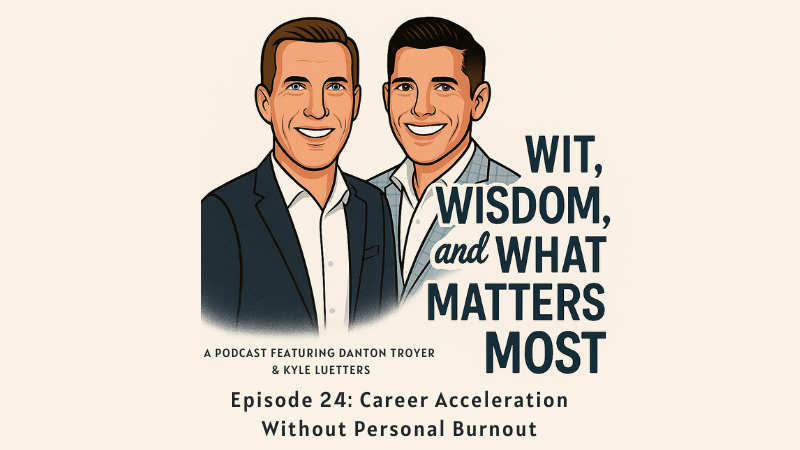
Episode Takeaways
Career success can look great from the outside while quietly costing you more than you realize.
In this episode, Sara Bell shares what happened when years of high performance, constant responsibility, and perfectionism finally caught up with her, and how she rebuilt a life and career that felt more aligned with who she truly wanted to be.
Danton Troyer and Kyle Luetters sit down with Leadership and Wellbeing Strategist Sara Bell, Founder of Strive to Thrive Coaching, to talk about burnout, leadership, identity, and the pressure many high achievers place on themselves. Sara opens up about her journey from chemical engineer to biotech executive, to eventually leaving corporate leadership to build a fitness franchise and a coaching business focused on helping leaders thrive without sacrificing themselves. The conversation explores why burnout often has less to do with workload than with values, boundaries, and self-worth, especially for executives who feel responsible for everything around them.
Key Takeaways:
- Why burnout is often tied to compromised values, lack of control, or blocked impact
- The difference between time management and energy management
- Why high performers struggle to transition into effective leadership
- How perfectionism and people-pleasing quietly erode capacity
- The role financial planning played in Sara’s ability to leave corporate life with confidence
- And more!
And more!
Connect With Danton Troyer:
- Moneta Group
- LinkedIn: Danton Troyer
- dtroyer@monetagroup.com
- (314) 735-9087
Connect with Kyle Luetters:
- Moneta Group
- LinkedIn: Kyle Luetters
- kluetters@monetagroup.com
- (314) 536-8297
Connect With Sara Bell:
About Our Guest:
Sara Bell is a leadership development consultant, executive coach, and entrepreneur with more than 20 years of experience in the life sciences industry. After building a successful corporate career in biotech and commercial leadership roles, Sara experienced firsthand the pressure and burnout that often come with high performance and constant career acceleration. Today, she helps leaders and organizations develop healthier, more sustainable approaches to leadership, growth, and performance through her coaching and consulting business, Strive to Thrive Coaching. Sara is also the owner of a Hotworx fitness franchise in Massachusetts, where she continues to build community and advocate for wellness, resilience, and intentional living.
Transcript
[00:00:00] Intro: Welcome to Wit, Wisdom, and What Matters Most with Danton Troyer and Kyle Luetters from Moneta Wealth Management. In this podcast, we help corporate executives and business leaders navigate the real-life uncertainty around new financial life stages, from complex benefits and career changes to retirement and legacy planning.
Join us as we explore these career and life shaping moments with our guests, helping listeners find clarity so they can focus on what matters most to them.
[00:00:32] RJ Malyk: Hello and welcome to Wit, Wisdom, and What Matters Most podcast with your hosts Danton Troyer and Kyle Luetters. I’m RJ, your podcast producer. Danton and Kyle, as always, good to see you. I see you have a guest lined up, so you’ve got something special going on. So what I’m gonna do is just throw it to both of you and take it away.
[00:00:53] Danton Troyer: Yeah, today’s guest is Sara Bell, and I think she has some very unique perspective, especially with talking about the [00:01:00] executives that we talk with. But her coaching and then her background leading up to that coaching, I think, is what is especially unique and gives her just a different perspective on everything that we’re gonna talk about today.
But today, this topic is career acceleration without the burnout. And so again, I think Sara’s gonna be able to provide some different perspective on that as well. So Sara, I don’t wanna steal your thunder as far as your background ’cause you have a very unique story, and you’re definitely gonna tell it better than I can.
Can you just give us maybe the 30-second or shorted up background on kinda how you got to where you are now?
[00:01:29] Sara Bell: Sure. So I spent 20 years in the life sciences industry, 11 years at a biopharma company, and then 10 years in a commercial role at a life science company. And I ended up opening a franchise, a fitness business, in 2021. Did that about three years toward the tail end of my corporate career. And then two years ago, left my corporate career to pursue a passion of mine, which is coaching and consulting, and opened my own leadership development, [00:02:00] high-performance career coaching consulting agency, and that’s what I’ve been doing for the last two years now.
[00:02:06] Kyle Luetters: Yeah. That is- … a very interesting- … career arc coming from someone that now messes with numbers that’s spoken to a mic professionally. I’ll give you the credit on that one.
[00:02:17] My first question, and as I was kinda doing some research for this, you have a Hotworx franchise. My opening question is- … you have two very tall, lanky dudes on this podcast with you, would we survive one of these classes?
Danton Troyer: Oh, no
[00:02:32] Sara Bell: Yes, 100%. It might be a little bit tight-
Kyle Luetters: Okay, thank goodness
Sara Bell: … for you in there because the saunas- … are designed to be a certain size to give everyone equal exposure to the infrared, so. Yeah, taller people do tend to have some challenges
[00:02:47] Kyle Luetters: As we tend to do, Danton more than myself. But yes, tall people do seem to have challenges.
But let’s go back to your, I would say maybe your early career. What were some of the things that you were experiencing? Walk us through the corporate career; where did you [00:03:00] start? And tell us a little bit about what was the tipping point? Like, when did things start to kinda shift in your mind, in your heart, in your soul that this may not be the long-term path for you?
[00:03:11] Sara Bell: Yeah, so for school, I was a chemical engineer, but have never held-
Kyle Luetters: Holy smokes
Sara Bell:… an engineering degree since then. So I did an internship at my first biopharma company, Amgen, a huge global biotech company, and got a job right out of school. They guaranteed us a job, but it just happened they needed people in manufacturing.
So here I went through four years to get a chemical engineering degree and ended up working on the manufacturing floor for six years wearing full clean room bunny suit. Yeah.
[00:03:46] Kyle Luetters: yeah. Oh, wow. Yeah. Nice.
[00:03:48] Sara Bell: And honestly, it was the best thing that I ever did because I learned from the ground up how to manufacture a biopharmaceutical and build [00:04:00] relationships, understand the process.
So that really opened doors for me, and from that point on, I moved into a project management role and was part of the site PMO, leading huge capital projects, commercial transfers from one site to another as we launched clinical and commercial products, and then wanted to take on leadership and management, so moved into a completely new space, quality control, environmental monitoring, clean utilities, using some scientific language here.
But- … just a very varied career path, which is a great thing in a big corporate entity. You have a lot of mobility and opportunity to move around and try different things. So that was all well and good, and then a previous coworker had reached out to me about coming, making the leap to a different company, which was a huge change for my family.
We moved from Rhode Island to Massachusetts when I took that job. And it was a big career shift for me, so that was the big test of, here I’ve built this strong [00:05:00] reputation, really grown and accelerated my career at Amgen. Am I gonna be able to do that at a new company, and how am I gonna do that?
And so I think a lot of high performers face that, right? They… How do they prove their success, and how do they do that in a new place? And so I really had to tap into my strengths, building relationships, my technical background, and what I could bring into a commercial role. And I found that I did that really easily and seamlessly, and again, was able to accelerate my career in this new place and rebuild that reputation very quickly.
And so I was growing fast in my career. I was expanding scope and responsibilities every couple years, but I really wasn’t getting the coaching and the support of how to successfully transition from a high-performing individual contributor to an effective leader, and how you make that change.
And so I was doing what had always worked for me, just grinding it out, working really hard, [00:06:00] delivering high results and high-quality results. But with that, when you increase your scope and the number of people that are reporting to you, and you’re still trying to be the doer and be perfection all the time- That’s where it started to really erode what I call capacity, and my ability to handle everything physically, mentally, emotionally. And then just always having that gut check of, is what I’m doing really aligned with what drives me, and where my impact is?
And again, in big companies, you have the luxury of being able to move around, but you also are at the disposal of the company every couple years when their leadership changes at the top and restructuring. So my role was changing a lot. I was being…I was seen as high potential, so I was being moved around a lot, usually to the areas that needed help or needed problems solved. And so it was just one challenge after the other, and it got [00:07:00] very exhausting.
And I think the breaking point for me was in 2019, I was placed into, or tapped for, a big role, a head of a huge part of our organization, our fastest growing business line. And it was a huge developmental step for me, and I took it and built a strategy, everything was going well. This is, I took it kind of 2018, 2019, getting into execution of the strategy, and we started facing some supply disruptions, and then COVID hit.
And so it … I was working in life science for the product line that provided everything for vaccine manufacturing. So demand went through the roof. And I was in the seat where everything came to me. All the problems, all the decisions. The government was involved in prioritization of our [00:08:00] product and our demand. And yeah, it was at the same time my kids were young, in school, kindergarten and second grade, homeschooling, and I was just on the computer all day trying to handle so many things that were outside of my control.
And so that was the tipping point for me, and where I realized I needed help and went to my manager and said, “Listen, I’m either gonna quit or I need some serious support.” But I had waited far too long to ask for that support.
[00:08:30] Danton Troyer: Yeah, that’s what I was gonna ask. What do you see or what warning signs were kinda leading up to that?
It sounds like maybe in hindsight you reacted too late, but you coach people now, so what are you helping them start to look for in advance before they get to that tipping point, as you put it?
[00:08:44] Sara Bell: Yeah, it’s having that self-awareness and understanding and looking for those signs. For me, I started just putting work before everything else in my life and deprioritizing the things that I needed to help me [00:09:00] recover, to help me rest, to help me manage the mental load, the decision fatigue, the emotional regulation, because I was so driven by making sure everything was perfect and that I wasn’t gonna fail in this role, that I felt like I was being judged by everyone to see can she handle this? Can she make it? That you’re afraid to ask for help. Yeah. You just keep pushing through, and you’re afraid that weakness, asking for help and support is gonna be seen as a sign of weakness, and I just started taking every problem on as my own, and that emotionally just kept weighing on me.
So signs that you need to look for is not just exhaustion at the end of the day, but really that feeling of complete overwhelm where you don’t know what to do. You feel like you can’t make decisions. You just wanna escape. Many people feel like, “Oh, I’m just gonna take a different role,” or, “I’m gonna change [00:10:00] companies,” but the problem doesn’t go away because its core, at its core, it’s who you are, right? And you’ve lost all sense of who you are, your values, what’s important to you, and how to set boundaries in alignment with those things.
And so it’s not that people burn out because of overwork. Most high performers love to work. I find that burnout happens because of one of three things, or any combination of these three things, and it’s really about understanding your values because you’re likely compromising a value.
You are having too many things come at you at once that are outside of your control
Or your ability to create meaningful impact has been blocked for some reason. So that could be as a result of something that’s outside of your control.
But it’s [00:11:00] usually one of those three things that is causing people to burn out. They’re just so busy that they don’t stop and reflect that one of those things is actively happening. And so over time, it starts to build and build until there’s this tipping point where they just feel like they can’t go any further.
[00:11:15] Kyle Luetters: It’s interesting you mention all these things, ’cause 2020, COVID, the whole nine yards, it just seemed like for a lot of people, it was very much a life-defining event.
It’s career defining, but it’s also a life-defining event. You mention your kids being the ages that they are. My kids are those ages right now, and I commend everyone. I was really lucky that I had very little kids going through that whole ordeal. We didn’t have to worry about school or this or that, so we didn’t really experience as much of some of that additional education and school load at that time, and gosh, trying to keep them busy.
With that being said, when you went and you asked your manager or your leader, and you talked to them about that, how long after that did you decide that, that this was it? And I’m gonna [00:12:00] basically shift tracks, because spoiler alert, the world’s in chaos a little bit in 2020, in case you didn’t know that, everybody.
What finally was the thing that, the final moment that got you to go out on your own and do something different from the wonderful career path that you were on?
[00:12:16] Sara Bell: Yeah. So the seed to eventually leave corporate was planted right when I took that big opportunity. It was, I looked ahead and was like, “I’m not sure that this is what I want.”
I liked what I did, but when I looked ahead, and I looked at, are you just exchanging more time and stress for money as you go up the ladder, is what I was experiencing at my company. And I just knew it wasn’t the life that I wanted. And so it was at that point that I had started looking at Hotworx, and filled out the franchisee questionnaire. And so that was the first step, to explore this, see what happens. So we actually opened our Hotworx studio in December of [00:13:00] 2021. So that process moved fairly quickly, but yeah, here I was opening a fitness center in the midst of the pandemic. But one of, one of the things when you go through burnout recovery or are working with a coach, which is what I did, is they say to find other things that fuel your passions, that give you meaning outside of your work.
And although it seems counterintuitive, because you’re adding more to your plate, and you’re already very overwhelmed and busy, it is really helpful for people. Because again, they’re doing something that’s very much in alignment with what fuels them, what’s important to them, their values. They’re able to have an impact in a different way.
And so I feel like doing that actually helped me recover from my burnout because it made me realize that work wasn’t life. Work wasn’t everything that defined who I was. Work wasn’t my identity. And it gave me something else and I was able to continue working in corporate [00:14:00] through 2024, and recover successfully from that burnout, I think, as a result of doing that, making that decision to work on Hotworx outside and do that in parallel.
And what that also did is gave me financial security and a financial foundation to be able to make the decision to leave, and it wasn’t an easy one. Because again, you know- who I am, Head of Marketing Sara Bell, was all I had known for 20 years, and so leaving that part of my identity behind was a very hard decision.
[00:14:36] Danton Troyer: Yeah. I think that was my question, is we’re finance guys. To me, leaving a job, especially I’m assuming you’re making pretty decent money at that level, and then you’re not. But it’s like you transitioned to that. How much planning did you and your family have to kinda think through to, to go, be comfortable enough to step away?
[00:14:52] Sara Bell: Yeah. So we had started planning, I would say, five years before I really left my corporate job, and maybe [00:15:00] even eight years before is really when we started working with a financial advisor and just getting kind of everything in order. We consulted with them when we opened Hotworx, and then as we were planning for me to be able to have the option to leave my job, yeah, we were putting together very detailed plans to make sure financially it was an acceptable thing to do and what that would look like and how much ground we’d have.
[00:15:27] Danton Troyer: Yeah, that’s interesting, ’cause we were talking about the story, and obviously you can tell it very quickly, so it sounds like you just went from corporate to Hotworx in a minute. Yeah. But obviously it’s not like, yeah, you did it all.
[00:15:35] Kyle Luetters: Successful entrepreneur just right off the bat.
[00:15:36] Danton Troyer: But there was obviously a real story behind that, that it did take some time to get that up and running and feel comfortable to be able to really pursue that as well.
So I think a lot of people, there’s days we all wanna be like, “I’m done. I’m not working anymore,” but that wasn’t necessarily the advice. It was more of taking some time, and you did spend a lot of time thinking it through, and I’m assuming now you’re very happy with the decision you made as well. I think that’s great that you’re able to do that and feel comfortable with it as well.[00:16:00]
[00:16:00] Sara Bell: Yeah. Thanks.
[00:16:02] Danton Troyer: One of the other questions was, at least through work, and it sounds like you had a little experience of this with bosses and maybe different positions that are offered or, I don’t wanna say pushed, but what boundaries do you see for folks, especially at that executive level, that they’re really important to make sure that they are keeping that work-life balance?
And I was actually talking with our marketing person the other day, and I don’t remember where I was, but I wasn’t at the office. She said, “Are you working today?” We don’t have to… I’m like I don’t know, I work kinda every day, all the time sometimes, but what is work? It’s just life. But what are some of those boundaries that you see that are important for folks so they can avoid just this burnout?
[00:16:37] Sara Bell: Yeah. So much we talk about time management and boundaries around time, right? But it’s more so about energy management. And when I say energy management, time is a finite resource, but energy can be recharged. And so are you defining boundaries around making sure you’re showing up in the best [00:17:00] way possible?
So are you eating well? Are you sleeping well? Are you moving your body? Are you taking time to recharge? Are you taking time to reflect and better understand who you are and what you need to learn and prepare for? I think we live in a world today where, especially leaders, are just so busy. We wear busyness like this badge of honor, and being triple-booked just means you’re more important, right?
But- … is that the most effective way to lead? And so I think when you see impactful leaders, they are very intentional about how they manage their energy and set priorities and manage their day so that they’re showing up cognitively as sharp as they can be. The way they decide what they work on at what point in their day, the decisions they’re making versus the decisions they’re delegating.
So boundaries aren’t just [00:18:00] what time you’re gonna start working and what time you’re gonna stop working, and if you’re working at nights or on the weekends, right? It’s so much more about where you spend that time and energy, what meetings you’re attending, how you’re developing your team, what you’re delegating, what you’re willing to review and oversee, and what you’re not, right?
And sometimes that means disappointing people. Sometimes that means not being there for someone when maybe you should be, and sometimes that means letting a ball drop to help someone else grow and develop as a result. And I think that’s really the hardest part that leaders have in their transition, especially out of high-performing individual contributor to leader, is they can’t do everything themselves and be responsible for success across everything. They have to pick and choose, and that’s really hard when you’re a people pleaser and a [00:19:00] perfectionist.
[00:19:00] Danton Troyer: I’ll say a perfectionist, yes.
[00:19:02] Sara Bell: Yeah. And, and ultimately, not to get too deep here, but a lot of that comes from a lack of self-trust, a lack of self-worth, a lack of self-belief. And so a lot of people just need to really understand kind of the root of that, where that comes from, so that they can work on overcoming those things so that they don’t hold them back, and they feel confident saying no, even if that means saying no to a leader above them, which a lot of people feel like they can’t do.
[00:19:34] Kyle Luetters: You work with a lot of people that are high-performing individuals. You coach them into being high-performing leaders. This question comes up often, but can anybody be a leader, a highly effective one?
[00:19:48] Sara Bell: I think it comes more naturally to some people. There are just innate leadership qualities that some people have, or they don’t.
That doesn’t mean that anyone can’t [00:20:00] overcome some of those things. I think most innate leaders naturally want to lead. It just alignes with what drives them and what their values are. They’re driven by wanting to have impact. So I think, I really test people to understand is leadership what they want, or is leadership just what they think they should want or they think needs to be their next step?
And I think a lot of companies now are realizing that just because you’re effective and very good at your job doesn’t mean you need to be a leader, right? They’re creating higher level technical roles, higher level roles where you can excel in it and make a good salary without being a leader, because not everyone is meant to be a leader, just like not everyone is meant to be an entrepreneur. I think it’s very glorified in our society today, but it’s not for everyone. [00:21:00]
[00:21:00] Kyle Luetters: I think that’s a very important thing to put out there, because I almost feel like in the ’80s and the ’90s, especially at a lot of bigger companies, and some of the small ones too, but even a lot of the bigger ones is like you would take the best performing salesperson and immediately put them in the sales manager role.
And then the company would wonder, like, why they’re struggling. It’s no, you took your best literal salesperson, which is a very unique skill set, and then you just copied and pasted and figured, “Well, if I can just get this person to tell all these other people what they do, then we should be great, and that should make them a great leader,” and that always wasn’t the case.
That’s where that question comes from because to your point, and in what you’ve laid out is very true, like- there are some people that are very good and leadership comes naturally, and there are others that the actual widget building or the actual task is very natural to them.
My dad was an entrepreneur, and that came very natural to him. He was very good at his craft. The [00:22:00] most stressed out he ever was when he had to lead people, and he said, “I’m getting out of that business completely.” But there were other people that came along and said, “That actually doesn’t sound like a bad gig.” So … it’s just an interesting type of a deal.
So bring us now fast-forward a little bit. There’s a lot going on in your life. I was checking you out on LinkedIn and everything like that. You are seemingly everywhere. What’s a day in the life look like for you now versus what it used to look like back in corporate America days?
[00:22:28] Sara Bell: It doesn’t look that different. I am very much a creature of habit, so I still wake up at 5:00 AM. I go to the gym at 6:00 AM. That is my non-negotiable. My family really won’t talk to me unless that happens, ’cause I’m not always a nice person.
[00:22:42] Kyle Luetters: Do you need coffee too?
Sara Bell: Yes, coffee.
Kyle Luetters: Because if so, I can introduce you to my wife as well.
[00:22:49] Sara Bell: So yeah. Coffee on the way to the gym, and then again after.
But yeah, so I, for Hotworx, I’m not there day-to-day managing that business. I have a full-time general manager and part-time [00:23:00] employees, but I’m physically there. I work out there every morning, so I have a presence. I’m part of the community. That is something that’s very important to me. I didn’t open that to franchise multiple locations.
I really did it because I wanted to make a difference in my community from a fitness, an accessible fitness, and I love that I’m part of that community. So that’s something that’s very important to me. Slightly off topic, but yeah, so that’s my morning. I come home. I get on the computer. I either have client calls or I’m doing content, or…
I’m not super, I would say, strict in my time breaks between Hotworx and Strive To Thrive Coaching. It’s more about, okay, what are my priorities this week? And I just… It’s not two hours here and four hours there. It’s just what do I have to get done, and that’s what I do. They blend and merge in my day-to-day and my to-do list.
But I’ve learned [00:24:00] since leaving corporate, I remember the first day I logged on my computer after not having a full-time corporate job, and I was like, “What do I do?” Outlook is not telling me what meetings I’m supposed to go to. So I’ve had to really figure out- A system and a process, even how I manage calendars, ’cause I have different Google calendars for different, for Hotworx, for Strive to Thrive.
Like, how do I compile everything so I can see everything in one place? I miss those elaborate corporate systems that you just have access to and you take advantage of when you’re in those jobs. But figuring that out, figuring out how to prioritize, how to really challenge what I can get done in a day’s time and being super intentional about the right activities that are gonna move both of my businesses forward, and sometimes that’s different for each one.
And then my kids, basically 4:00 to 9:00, I’m a taxi driver for my kids, driving all over the state of [00:25:00] Massachusetts to get them to sports and practices, and I love that I can be at all of their games now. So that’s something that is very important to me.
[00:25:09] Kyle Luetters: It’s interesting, ’cause when those things kinda come into place, you often think about, “Do we really need robo-taxis?” And then you get into kids’ activities, and you’re like “yeah, not a bad idea.”
[00:25:20] Danton Troyer: Yeah, my daughter started driving, and it’s like, oh, the best thing ever. It… There’s some caveats to that, but generally speaking, when it comes to activities, it’s so much easier, obviously, but also very scary.
One of the things you said about missing some of the just system access, but is there anything else you miss on a day-to-day basis from corporate life?
[00:25:39] Sara Bell: The people, the community, coworkers.
[00:25:42] Danton Troyer: Yeah.
[00:25:43] Sara Bell: Yeah, so-
[00:25:44] Danton Troyer: Yeah, I can imagine … [00:25:44]
Sara Bell: That to me, is the hardest part, but I’ve been, again, intentional about building that community and that network, so I feel that in some ways again.
[00:25:53] Danton Troyer: Yeah, I was gonna say, I felt like with the Howorx, you’ve kinda got a little bit of a community, at least in the morning.
Yeah. And then obviously, clients are more one-on-one, but at least you got something going for you [00:26:00] as well.
[00:26:00] Sara Bell: Yep. Yeah, and networking groups, different industry groups, communities, things like that, where you can surround yourself with people that are trying to do similar things, have similar pain points and challenges. It’s always good to help you and be comforted that other people face the same challenges.
[00:26:19] Kyle Luetters: Before we light on out of here, Sara, is there anything that throughout your journey, if you were to put a bow on this experience that you are still currently living, is there any couple word phrase or even short sentence that you would use to summarize everything you’ve been through and what you’ve learned?
[00:26:39] Sara Bell: Uh, I think just to summarize it is that we have so much more power and choice over our future than we believe.
[00:26:51] Kyle Luetters: I like that. I like that a lot, yeah.
[00:26:52] Sara Bell: And yeah just, I challenge people that say, “I don’t have a choice,” or, “This is what I have to do,” or, “I can’t quit my job.” [00:27:00] We always have a choice. It’s just you’re-
[00:27:03] Danton Troyer: Not always easy,
[00:27:03] Sara Bell: the actions that you choose to take.
[00:27:06] Kyle Luetters: If folks are wanting to find out more about you or connect with you, where can they… what’s the best place for them to connect with you, Sara?
[00:27:14] Sara Bell: Yeah, I would say LinkedIn is the best place. You can just look up Sara Bell, Strive to Thrive Coaching, and that’s the best way to find me.
I have a website as well that’s linked right off of that, strivetothrivecoaching.net. But yeah, happy to connect.
[00:27:29] Kyle Luetters: It’s perfect, and it’s easy to spell, too – eight letters.
[00:27:32] RJ Malyk: Yeah. Perfect.
[00:27:34] Kyle Luetters: Short and sweet. Awesome. Thank you.
[00:27:36] RJ Malyk: All right, gentlemen, before you go, Danton, contact information?
[00:27:38] Danton Troyer: Yep, the website for the podcast and to reach us directly is witwisdomandwhatmattersmost.com.
You can find us there. Then if you wanna link to us professionally, there’s a link there as well.
[00:27:53] RJ Malyk: ll right. Kyle, wanna add anything?
[00:27:55] Kyle Luetters: This is a fantastic conversation, as they always are. Sara, thank you for being an [00:28:00] incredibly insightful guest and also encouraging us to, though they might be cramped quarters, still try Hotworx yoga at some point.
[00:28:10] Sara Bell: Most definitely.
[00:28:11] Kyle Luetters: And make good choices as to how we contort it. Yep. Got it.
[00:28:15] Sara Bell: Thank you so much for having me. Excellent. This was great.
[00:28:17] RJ Malyk: All right, thanks, Sara. All right. Thanks, Danton and Kyle.
Looking forward to your next podcast, and thank you for listening to today’s Wit, Wisdom, and What Matters Most podcast.
Please like, follow, and share this podcast with friends and family. Until our next Wit, Wisdom, and What Matters Most podcast, I’m R.J. Malyk.
[00:28:36] Outro: Thank you for listening to the Wit, Wisdom, and What Matters Most podcast. Click the follow button to be notified when new episodes become available. Visit our website at witwisdomandwhatmattersmost.com to learn more and find additional ways to connect with us in the show notes.
The opinions voiced in this podcast are for general information only and are not intended to provide specific advice or recommendations for any individual to determine which strategies or investments may be suitable for you.
Consult the appropriate qualified professional before making a decision. Investment advisory services offered by Moneta Group Investment Advisors, LLC, an investment advisor registered with the Securities and Exchange Commission. Registration does not imply a certain level of skill or training. The information [00:27:00] discussed in this podcast is for informational and educational purposes only, and represents the views and opinions of the guest and or host, and does not necessarily represent the views and opinions of Moneta.
You should consult with an appropriately credentialed professional before making any financial investment. Tax or legal decision. Past performance is not indicative of future returns. All investments are subject to risk of loss. Please see disclosure for additional information.
© 2026 Advisory services offered by Moneta Group Investment Advisors, LLC, 190 Carondelet Plaza, Suite 1200, St. Louis, MO 63105 (“MGIA”), an investment adviser registered with the Securities and Exchange Commission (“SEC”). MGIA is a wholly owned subsidiary of Moneta Group, LLC. Registration as an investment adviser does not imply a certain level of skill or training. This is an advertisement. The information
contained herein is for informational purposes only, is not intended to be comprehensive or exclusive, and is based on materials deemed reliable, but the accuracy of which has not been verified. Examples contained herein are for illustrative purposes only based on generic assumptions. Given the dynamic nature of the subject matter and the environment in which this communication was written, the information contained herein is subject to change. This is not an offer to sell or buy securities, nor does it represent any specific recommendation. You should consult with an appropriately credentialed professional before making any financial, investment, tax, or legal decision. Past performance is not indicative of future returns. You cannot invest directly in an index. All investments are subject to a risk of loss. Diversification and strategic asset allocation do not assure profit or protect against loss in declining markets. These materials do not take into consideration your personal circumstances, financial or otherwise. Trademarks and copyrights of materials linked herein are the property of their respective owners.