
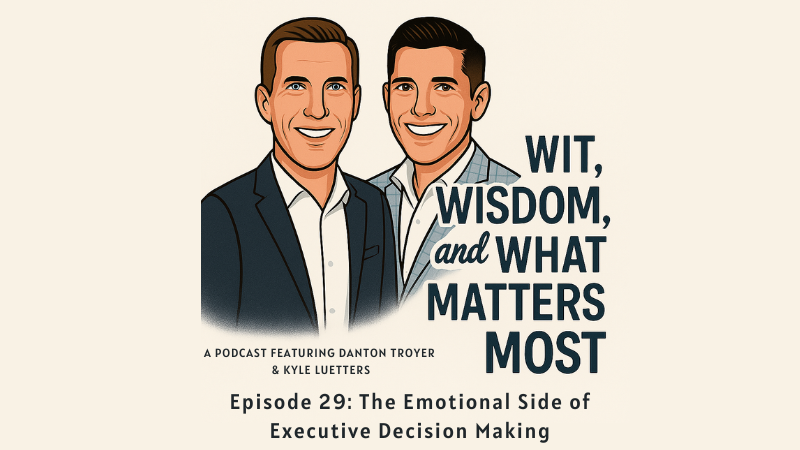
Episode Takeaways
High-stakes decisions can feel surprisingly isolating, especially when the consequences affect a company, a career, or hundreds of other people. How can leaders think clearly when pressure, confidence, and uncertainty collide?
In this episode, Danton Troyer and Kyle Luetters talk with Mike Warner, former general counsel at ALX Oncology, about decision-making under pressure. Together, they examine how trust and self-confidence can reduce executive isolation, why complex problems rarely benefit from rushed answers, and what the AOL-Time Warner merger shows about unchecked confidence.
The conversation also explores the value of listening to dissenting voices, remaining calm when circumstances escalate, and developing the perseverance needed for long-term decisions.
Mike discusses:
- How trust in yourself and your organization can reduce the isolation that comes with high-stakes leadership decisions
- Why rushing toward a quick answer can leave leaders exposed to risks and consequences they haven’t considered
- How excessive self-confidence can prevent executives from giving enough weight to criticism and outside perspectives
- Why calmness helps leaders assess difficult business situations without allowing a panic response to drive the decision
- How experience, listening, and perseverance can support clearer thinking when the stakes and pressure continue to rise
- And more!
Connect With Danton Troyer:
- Moneta Group
- LinkedIn: Danton Troyer
- dtroyer@monetagroup.com
- (314) 735-9087
Connect with Kyle Luetters:
- Moneta Group
- LinkedIn: Kyle Luetters
- kluetters@monetagroup.com
- (314) 536-8297
Transcript
[00:00:00] -: Welcome to Wit, Wisdom, and What Matters Most with Danton Troyer and Kyle Luetters from Moneta Wealth Management. In this podcast, we help corporate executives and business leaders navigate the real-life uncertainty around new financial life stages, from complex benefits and career changes to retirement and legacy planning.
[00:00:21] -: Join us as we explore these career and life-shaping moments with our guests, helping listeners find clarity so they can focus on what matters most to them
[00:00:32] Kyle Luetters: And welcome to another edition of Wit, Wisdom, and What Matters Most. It’s a podcast with Moneta’s Gast Freeman Troyer team. My name is Kyle Luetters, joined by Danton Troyer.
[00:00:42] Kyle Luetters: And Danton, a very special guest today, someone that is gonna know a lot more big words probably- … than you and I will. Spent a lot of time in the legal field, but we’d love to welcome Mike Warner to Wit, Wisdom, and What Matters Most. Mike, how are you doing today?
[00:00:58] Mike Warner: I’m great, guys. How y’all [00:01:00] doing?
Danton Troyer: Ah, can’t complain.
[00:01:02] Kyle Luetters: Doing really great here. Real quick, Mike, just as we kinda get the podcast going a little bit, can you kinda tell the folks that may be listening or watching a little bit about yourself? You know, you’ve had a long career at a fairly large company, and then now have transitioned into an encore career that is actually pretty interesting as well.
[00:01:22] Mike Warner: So I started my life as a, as a, a chemist working for Monsanto here in St. Louis. Became interested in going to law school, and eventually graduated from law school, going in the evening division, St. Louis University. And started work as a patent attorney for Pfizer, also in St. Louis. And worked there for a while, retired from, from Pfizer, went to work for a small biotech in California called ALX Oncology as their general counsel. Retired about three or four years ago
[00:01:56] Danton Troyer: How’s the shift into retirement been for you, Mike?
[00:01:59] Mike Warner: Oh, super. [00:02:00] Right now I’m, I’m spending my time writing. I write for an online magazine in New Orleans called The French Quarter Journal. Been having a lot of fun there interviewing people and telling history stories.
[00:02:11] Mike Warner: And just last year had a biography published with the University of Louisiana Press called “Charles Whitfield Richards, the Artist and his Circle.” It’s about an artist and journalist in New Orleans and on the East Coast.
Kyle Luetters: Oh, interesting.
Mike Warner: Having a lot of fun, learning a lot of things.
[00:02:28] Kyle Luetters: So I wanna pull on a thread, just even for my own personal knowledge, but what’s the ties to the New Orleans area? Because in hearing you talk about that, there’s some sort of pull there. I was curious what the connection is.
[00:02:42] Mike Warner: Right, I was born and raised in New Orleans, went to high school there, and after high school moved away. But I still keep connections with all my high school buddies from Benjamin Franklin Senior High School, class of ’73.
[00:02:55] Mike Warner: Go Falcons!
[00:02:58] Danton Troyer: That’s great. [00:03:00] Yeah, ’cause we were talking beforehand about going on to your vacation property outside New Orleans, and I was like, that’s not very common for a place to go on a vacation. So that makes a lot more sense, for sure.
[00:03:11] Kyle Luetters: Yeah. So Mike, you’ve seen the inside…you mentioned Pfizer, Monsanto. You’ve seen the insides of a lot of large companies, and then one of the things that we really kinda wanted to talk to you about here was this concept of this emotional side of executive decision-making, and you’ve been a part of some big companies. So, kinda walk us through that. Why do high stakes decisions, especially at the executive level, feel isolating in your opinion?
[00:03:39] Mike Warner: That’s a really interesting question because it’s like you’re out there rock climbing, and suddenly, like you’re on the biggest rock face you’ve ever scaled, and you’re like hanging by a piton and a carabiner, and there’s nobody there to give you advice, and one false move and it’s all over.
[00:03:56] Mike Warner: You’ve lost everything. And so it’s both [00:04:00] exhilarating and it’s scary. Maybe let’s take an example. Let’s say we have an executive, Sally, and maybe she’s gotten her job because she’s made some important decisions. And for the most part, they’ve been good decisions. She has a good track record. And, uh, and I think there’s a personality type who thrives in these positions.
[00:04:21] Mike Warner: Someone who can look at a set of conditions, quickly analyze them, and decide on a path forward that in hindsight looks pretty good. Of course, you don’t know what hindsight’s gonna look like until you get there, but she has a good history. So as a good decision maker, I think Sally knows that she either has the skills to make this decision, these decisions, or she can get the right information and the right work stream from the people around her who do have the skills, right?
[00:04:53] Mike Warner: And so she kind of runs… she’s taking point. She signs off on decisions. She is [00:05:00] trusting that the people around her to provide her with good, accurate, timely information, and she’s trusting that her management is going to support her as well, even if there’s a risk of failure. And that’s actually, we’ve all seen managements that support you and managements that don’t give the support you need.
[00:05:20] Mike Warner: But let’s assume that for a strong organization that an individual like Sally is going to have the trust of her management. And she’s gambling also that the things that are outside her control don’t change in a negative way, the business environment or the company’s fortunes, or things like that.
[00:05:40] Mike Warner: Things are traveling along. So some people can get really excited about this kind of opportunity, and some people get really nervous about these risks. And so a couple of important questions are, does Sally trust the people around her? And how much trust does she hold in [00:06:00] herself? When the trust in both of these is strong, then the feeling of isolation decreases.
[00:06:06] Mike Warner: And maybe to put it in mathematical terms, I think the isolation is directly proportional to the amount of ease or unease or trust in your own abilities or those around you So that kind of brings me to a topic that I’ve thought a lot about over the years. And we’ve been in good, we’ve all been in good organizations, we’ve been in less good organizations.
[00:06:31] Mike Warner: I wanna say that the companies I worked for have all been superb. But nonetheless, people have, are… You know what? A, a large company might have 100,000, 50,000, about 200,000 employees, and that’s like a city, right?
[00:06:46] Danton Troyer: Exactly, yeah. Bigger than the city I grew up in.
[00:06:46] Mike Warner: And in any city, you’re going to have a lot of good people, and you’re gonna have some butt heads.
[00:06:55] Danton Troyer: Sure.
[00:06:56] Mike Warner: And so in any large company, you have to kind of navigate [00:07:00] things. There’s a worry that some people might have that your colleagues might let you fail. And, or even worse than that, in a dysfunctional organization, there’s the fear that some colleagues might even want you to fail or want to hold you back.
[00:07:17] Mike Warner: And that’s kind of a reductionist statement, isn’t it? I mean, it doesn’t apply to everyone, it doesn’t apply to all situations, and it only applies to the extent that there is a dysfunction in your organization. But there’s, it happens, and there’s a lot of truth there, and I think this feeds into, this piles up with the problem, with the feeling of isolation.
[00:07:39] Mike Warner: So for example, some of your colleagues, maybe you’re out one day having beers with your buddies and cracking jokes, and the next day you get a promotion, and maybe this is a promotion that one or two of your colleagues wish they had had for themselves. And so maybe they’re a little less, they’re a little jealous, a little less cooperative, a little less friendly about it.
[00:07:59] Danton Troyer: Yeah.
[00:07:59] Mike Warner: Or [00:08:00] maybe there’s someone in your organization who’s a malcontent, or, and we’ve all seen or experienced schadenfreude. That is the sense of pleasure that one might sometimes feel in seeing other people fail.
[00:08:14] Mike Warner: Or maybe they have competing goals. Maybe somebody in your organization’s on a different project competing for the same resources, and so they have an economic or a goal-related reason to see you held back a bit from your goals. Or maybe even your management, especially in the area of career moves, might want a different outcome than you want.
[00:08:35] Mike Warner: Maybe you want a promotion. Maybe they think that should go to somebody else. An example from my own career is I mentioned that I was a chemist and decided to go to law school, and I thought, “Wouldn’t that be cool if for the company I was working for at the time, if we had a chemist who had a legal background, or an attorney with a chemical background?”
[00:08:57] Mike Warner: And I think that for some companies, [00:09:00] technology companies, that’s a great combination. So I went to my management, actually a couple layers up my management, and made that suggestion, and the fellow said, he said, “I think it’s a great idea, but if you want to do that, you need to quit.” And I didn’t want to quit.
[00:09:16] Mike Warner: So, I went to law school surreptitiously in the evening division at St. Louis University. And eventually they found out, and they were cool about it, and they actually, I actually got an opportunity to transfer into the company’s patent department. Best career move I ever made.
[00:09:32] Kyle Luetters: Oh, yeah.
[00:09:32] Mike Warner: And, and it was a great opportunity to expand my horizons and to, and it was a good salary move as well.
[00:09:41] Danton Troyer: Yeah, I would hope so, yeah
[00:09:41] Mike Warner:. And I learned a lot of new things, so it was a great move. So in these situations, I think what you need is enough self-confidence that you can find ways around these adversities. And to the extent that it’s an organizational dysfunction that’s causing the [00:10:00] isolation, you need to find a way to build one that’s more functional. Maybe the malcontent can be brought into the circle by including that person in decision-making on one or two programs, or maybe the malcontent needs to be shown the door.
[00:10:17] Danton Troyer: Yeah.
[00:10:17] Mike Warner: You think that, to summarize the idea about isolation, I think the way to decrease isolation is to have or build trust in your organization and to have trust in your own skills.
[00:10:32] Danton Troyer: Yeah. We certainly see you need a positive culture to make that decision-making, and the more people you can get involved, obviously the more buy-in you got as well.
[00:10:41] Danton Troyer: So there’s some decisions that are made at the executive level that you’re kinda on your own island, and you’re gonna face the consequences, whether it’s good or bad, when you’re making those decisions as well. That’s a great way to look at it, though, is the better team basically that you have put together around you, the less isolated you probably feel when you’re making those decisions as [00:11:00] well.
[00:11:00] Danton Troyer: One of the other things we were talking about is just you do have a lot of pressure in these positions to make good decisions. Can that sometimes distort how you’re seeing those problems potentially, the clarity around them? And because it is such a high-stakes decision that you’re gonna need to make, in some of these cases, especially in you’re part of these huge companies, and that affects a lot of employees, and one wrong decision or shift and people could lose their job and their livelihood. So were you ever in a position where you felt like it was… and then in hindsight as you point out, that the clarity just was difficult to get?
[00:11:32] Mike Warner: Oh, once or twice, yeah.
[00:11:33] Danton Troyer: Yeah, I can imagine. Yeah.
[00:11:36] Mike Warner: But there’s a tension, isn’t there? There’s, on the one hand, you have the pressure to come up with a quick answer to the problem that’s fallen into your lap, and your management and your client wants you to, would love for you to, come up with a solution right now.
[00:11:51] Mike Warner: On the other hand, many problems require a deep investigation and a careful consideration before you [00:12:00] act. And so do you act now? Do you hold off? A lot of people have built reputations by going to one – not good reputations – have built reputations going from one extreme to the other, acting rashly, and coming up with…
[00:12:15] Mike Warner: Sometimes you luck out and come up with a good decision, sometimes you don’t, and that can snowball on you.
[00:12:21] Danton Troyer: Yeah.
[00:12:21] Mike Warner: On the other hand, if you think about something too long, you’ll get a reputation for not being able to move.
[00:12:26] Danton Troyer: Indecisive.
[00:12:27] Mike Warner: Yeah, indecisive. There was a line I once heard, it’s sometimes true, “It’s better to come up with a bad decision than no decision at all.”
[00:12:35] Mike Warner: Sometimes that’s true, but it drives the point.
Danton Troyer: Ah, certainly.
Mike Warner: And so I think there’s different kinds of pressure. For example, there’s time pressure, there’s pressure of consequences, there’s also the pressure to be right. As for time pressure, sometimes you just cannot slow the moment down. There’s a PR disaster in progress, or there’s a regulatory deadline [00:13:00] that somebody just told you about, “Oh yeah, and by the way, we need this tomorrow.”
[00:13:04] Danton Troyer: Yeah.
[00:13:04] Mike Warner: And the FDA’s going to explode if you don’t get it to them. And or the marketing group wants a decision on something yesterday. And you wanna come up with a quick answer that solves the riddle and saves the day. Everybody wants to be a superhero. Everyone wants that big S on their chest.
Danton Troyer: Right.
Mike Warner: But for complex issues, a quick answer is really risky. And the risk of missing something or not mitigating the pitfalls is always in front of you. Or even understanding what the pitfalls are. Sometimes you go into something and you don’t even know what you don’t know.
[00:13:38] Danton Troyer: Yeah, that’s been difficult, ’cause you’ll work with clients sometimes, you always see they always want an answer now.
[00:13:43] Danton Troyer: And maybe misunderstanding the complexity that goes into that question, and we’re under the pressure to get the answer as fast as we can, but you also have to get to the answer, but it has to be right. It’s high stakes. You can’t be wrong on these things. So certainly understand where you’re coming from on that.
[00:13:58] Mike Warner: I agree. I agree. [00:14:00] And so that’s time pressure. And I mentioned also the pressure of consequences as a downside. And you could make millions, or billions, or you could lose your development costs and your opportunity costs in the event of failure. But the upside looks just so juicy that there, you might have a temptation to ignore all the pitfalls. We’ve all seen that many times, and we kind of have to hold ourselves back. Technology pitfalls…
[00:14:28] Kyle Luetters: We just went through that with a lot of folks with SpaceX stock. I mean, just so much euphoria and so much pent up excitement for all of this stuff.
[00:14:37] Kyle Luetters: And again, as I look at this, it’s trading down close to $100 below its high point. So sometimes long-term implications, to Danton’s point and to your point, Mike, you know, small table stakes, if we tossed a flyer here or there, that’s okay. But we actually had some conversations, at least I did, where some folks said, “Hey, this thing’s going to the moon.”
[00:14:57] Kyle Luetters: And I said, “Well, they actually crashed into the moon. [00:15:00] I would prefer they land.”
Danton Troyer: They didn’t quite make it.
Kyle Luetters: Yeah. But it was all kind of tongue in cheek, but it’s when you start adding, to your point, more zeros at the end of the number that could be impacted, and also I loved the point that you made about the number of people in an organization that can be affected, you really have to slow down that decision making.
[00:15:18] Mike Warner: And the blackout period on the stock for SpaceX. for all those employees is ending right about now. So it’s gonna be very interesting to see what happens to the company when that happens. But I call these situations the “here, hold my beer scenarios.”
[00:15:36] Kyle Luetters: Is that a technical term?
[00:15:38] Mike Warner: It is. It is. You’re using it. All the attorneys use it. And as an example, back in the year 2000, the chairman of Time Warner was a fellow named Gerald Levin, and you guys probably know this story, but on the table there was a merger with America Online – AOL.
[00:15:54] Mike Warner: Yeah. And, so this is a while back now, and so a lot of your listeners may not recognize that [00:16:00] AOL at… Yes, AOL’s still around, but back in the day, AOL was the precursor to the internet. This was before the internet really exploded. And AOL, and there are a couple of other ones, had these little sandboxes in which[00:16:17] you could do email and you can do… You had games and probably some word processing and stuff like that. And it was the big thing. AOL was probably the leader of these organizations of that nature. And so the merger, the idea was to meld this high tech with this entertainment company, and Levin was very confident in the merger.
[00:16:42] Mike Warner: The problem, one of the problems, was that in negotiating the deal, Time Warner did not put a collar on the transaction. And so for the folks listening who may not know what a collar is, if an acquisition target in a merger, if the stock price of that target [00:17:00] drops below a certain level, then the acquirer can renegotiate the deal or even walk away from it.
[00:17:07] Mike Warner: And on this deal, the Time Warner negotiators had neglected to put a collar on it. And then before the deal closed, the dot-com bubble burst- splattering everybody. And AOL stock dropped like a rock. Now, just because they don’t have a collar doesn’t mean they can’t renegotiate. They, you can try.
[00:17:29] Mike Warner: It’s harder to do so, and Levin’s advisors allegedly had implored him to reconsider the deal. But he was confident in it And by some estimates, it was a $182 billion deal, and it turned out to be an absolute disaster. It proceeded, he closed the deal, and the two companies never really merged. They were just two companies that are glued together, and there, other than some job reorganizations and things like that, there really was not any significant synergy [00:18:00] between the technology company and the entertainment company.
[00:18:04] Mike Warner: For one thing, AOL’s technology at that point had gotten pretty aged and had not- their technology wasn’t applicable much to Time Warner. And it, now, it of course is a textbook deal. These universities, law schools study this case-
Danton Troyer: Study that deal, yeah.
[00:18:22] Mike Warner: … as, as an extraordinarily bad merger. And they spun it back off, and both companies have went their separate ways. But it’s an example of, of a case where the pressure of the consequences was so high that the possibility, at least in, in the eyes of Mr. Levin, that he didn’t wanna back away from it, he didn’t give enough weight to the downside.
[00:18:41] Mike Warner: Now, you talk about isolation. There’s nobody more isolated at this point than, than, than Levin was.
[00:18:48] Danton Troyer: Yeah, I can’t imagine they were happy about that.
[00:18:50] Mike Warner: Yeah.
[00:18:50] Kyle Luetters: I wanna pull on that thread for just a second, because that is a very key element in leadership across the board, but especially high-level [00:19:00] executive type leadership.
[00:19:02] Kyle Luetters: How important, Mike, is it, you mentioned Mr. Levin here, but how important is it for a CEO or an executive to have people that are gonna, for lack of a better term, speak truth to power? And how important is that, is it for that leader to give credence when those folks raise their hand and say, “Hey, I don’t think this is a great idea,” even as you’re driving the van off of the cliff?
[00:19:28] Danton Troyer: Yeah.
[00:19:28] Danton Troyer: Yeah.
[00:19:29] Mike Warner: Yeah …
[00:19:29] Kyle Luetters: …so to speak? Can you speak to, maybe you’ve even have an example, but how important is it when it comes to whom executives surround themselves with and how much power they give to speak in to that leader?
[00:19:42] Mike Warner: I think it’s incredibly important because no one person, especially at that level of an organization, knows everything. That for a large company, the CEO simply cannot know how to turn the valves in the manufacturing plant, doesn’t know what the downsides are, doesn’t know what the risks are if [00:20:00] something spills, doesn’t know, doesn’t know the sales rep who’s out there in the field.
[00:20:05] Mike Warner: Maybe the CEO came up through the sales organization or something like that. But there are day-to-day issues that change, and the further away you get from your roots, the more you need to have current input. So it’s incredibly important to have people around you who can feed back to you, and it’s incredibly important to listen to them and not necessarily agree with – because you’ll have different advisors saying different things and pulling you in different directions –
[00:20:34] Mike Warner: But at least to, to give appropriate weight to the input around you and to seek it out, to in fact enjoy receiving it, be thankful for the input. When somebody criticizes me… So in terms of my writing career that I’m into right now, one of the things that I get into is workshops. What I do is I write something and I share my writings with my colleagues, and they [00:21:00] just hammer on it.
[00:21:02] Mike Warner: But it’s, I love it. It’s, and if you’re not afraid to be hammered on a little bit, then it’s a gift.
[00:21:08] Danton Troyer: Yeah.
[00:21:08] Mike Warner: Because if one person says, “Oh, I didn’t like it for this reason,” you can maybe safely ignore it. If two people are telling you, “I think this is a problem,” you better listen to that.
[00:21:17] Danton Troyer: Right …Yeah, we see that just in our careers.
[00:21:19] Danton Troyer: That’s why we use the analogy of family CFO. The client’s always the CEO, but we sometimes have to give that hard feedback that, “That thing you were trying to work on, and I don’t see how we can mathematically make it work.” But our job, of course, is to make it work and try to figure out what the best is.
[00:21:36] Danton Troyer: But it’s always give and take, and that’s where we have our best relationships as well, is folks that value our opinion. And that’s part of our job, is to help deliver maybe sometimes the not so great advice.
[00:21:46] Mike Warner: Exactly. And there’s kind of a, I mentioned the self-confidence and the rely on yourself, and also to take information from other people.
[00:21:54] Mike Warner: But in, for example, in Levin’s case, he was over-dependent on self-confidence.
[00:21:59] Danton Troyer: Yeah.
[00:21:59] Mike Warner: He didn’t listen to [00:22:00] the people around him. And as Dirty Harry would said, “You’ve got to know your limitations.”
[00:22:06] Danton Troyer: Perfect, yeah.
[00:22:08] Kyle Luetters: and I think one of the things, too, if you guys have ever seen the series that HBO did here a while back called Chernobyl-
[00:22:16] Mike Warner: Yeah.
[00:22:16] Danton Troyer: Yes.
[00:22:16] Kyle Luetters: Remember that relationship between the head scientist and the minister that was in charge of all of that, and the minister kept wanting to go in and, “We’ll just do this. We’ll just do this.” And he’s got an expert over here saying Legasov is always saying, “Look, you gotta stop doing this. You gotta stop doing this. You gotta stop doing this.”
And what to me was interesting about the entire crux of that series was how Shcherbina starts to listen to more, the hubris of his leadership dies, instead of just saying, “We can fix this real easy.” He started really relying on outside experts ’cause you start to see his metamorphosis throughout the entire thing because the implications of his decisions obviously affected [00:23:00] several tens of thousands, if not millions of people-
[00:23:04] Danton Troyer: Right
[00:23:04] Kyle Luetters: for many, many years to come.
[00:23:06] Mike Warner: Yeah. Yes, definitely right
[00:23:08] Kyle Luetters: So I just… I always thought that was really cool to watch that relationship morph over the course of that entire miniseries.
[00:23:16] Mike Warner: For sure. And it’s an example of maybe some decisions, not maybe, we know now, some decisions were taken far too late in that, the listening occurred far too late.
[00:23:27] Kyle Luetters: Correct. Mike, as we continue to carry on here, and there’s so many fascinating things behind this, but we talked about listening would’ve made a better decision up front, but what are some other things that create better long-term decisions? Listening’s probably one.
[00:23:43] Kyle Luetters: Listening sooner rather than later is better than, is probably good for long-term decisions. But is there anything else in your mind that when you watch high-functioning, very sought-after leaders make decisions, what are some of the things that create the best [00:24:00] long-term decisions in your mind, that we haven’t covered yet?
[00:24:02] Mike Warner: Well, we’ve talked about self-confidence, we’ve talked about trust, two very key things. I think another important point is calmness. Being able to coolly look at a situation that might be exploding. And evolution occurred and humans developed a panic reflex. And sometimes a panic reflex works great.
[00:24:26] Mike Warner: It might scare away an attacker, or it makes you run faster, or jump higher to get away from something.
But in a business situation, what you need to be able to do is, you’re not gonna scare away much by panicking. What you need to do is, I think, stay calm even when you’re up to your butt in alligators.
[00:24:48] Mike Warner: And I think that experience is one of the key factors which helps us stay calm in the face of adversity. An example of this, we’ve been talking about [00:25:00] some, some movies and things. There’s a great scene in the Coen brothers movie, The Ballad of Buster Scruggs, and there’s… I’ll see anything by the Coen brothers, they are just great.
[00:25:08] Mike Warner: And I just love that kind of semi-dark humor and the complex stories that they tell. But in The Ballad of Buster Scruggs, this movie is an anthology. It’s a series of short films all around a sort of a Western 1900s kind of a theme. And one of the stories is called Near Algodones.
[00:25:28] Mike Warner: Now Algodones is the town that today we think of it as a sort of a far-flung suburb of Albuquerque. But back in the 19th century, it was a tumbleweed town and where the cows outnumbered the people, and it was out of the way. I won’t give the story away, but it’s about a man’s emotional state as he faces his hanging and how experience in his life affects his attitude. So I’d encourage people to watch that.
[00:25:55] Mike Warner: But another point though is in [00:26:00] addition to calmness, is perseverance. I think the people who are successful persevere. If you don’t keep pushing, you’re not going to get to your goal. Even when there’s the occasional bump in the road or even a big solid wall, you find your way over, around, or through the wall.
[00:26:16] Mike Warner: And the perseverance I’d count very far up there
[00:26:22] Danton Troyer: Yeah.
[00:26:22] Kyle Luetters: Yeah. Mike, I really have enjoyed, and I’m sure I speak for Danton when I say, enjoyed this conversation immensely. It was very insightful. Always enjoy when we get the chance to chat because I feel like I come away a lot more worldly and definitely smarter.
[00:26:37] Kyle Luetters: And your comment about the cows outnumbering the people, that definitely did take me back to my hometown a bit.
Before we get on out of here, just real quick anyways, what’s on the horizon for you as far as your writing? Is there any more books in the canon? What’s keeping you now motivated, persevering, whatnot, as, as you’ve moved on into this new stage of life?[00:27:00]
[00:27:00] Mike Warner: I’m having tremendous fun with what I’m doing. People say that they worry about what they’re going to do when they retire. But I have not had a spare minute.
Danton Troyer: That is great …
Mike Warner: I keep writing. I have a speaking engagement for a writer’s group down in Alabama coming up in two weeks, and so that’s gonna be a lot of fun.
[00:27:20] Mike Warner: And I’m working on another book right now. My editor at the French Quarter Journal and I are collaborating on a book about artists who hang their work on Jackson Square in the French Quarter in New Orleans, and the history of that process. It dates back 100 years or so, and-
[00:27:36] Danton Troyer: Wow
[00:27:36] Mike Warner: and there’s a lot of very interesting characters who have been involved there. And also, in addition, I’m doing volunteer work. I take classes. I’m taking classes with the University of Cambridge starting in October, and I’m taking classes at Alliance Française, where I’m learning, relearning French.
[00:27:54] Danton Troyer: Oh, wow.
Mike Warner: Uh, doing volunteer work there as well; a great organization.
[00:27:59] Danton Troyer: Yeah, [00:28:00] that’s amazing.
[00:28:00] Mike Warner: Always busy.
[00:28:01] Kyle Luetters: I didn’t know how you had time to work at some point.
[00:28:05] Danton Troyer: I say we always talk to the clients trying to help them figure out what they’re gonna do in retirement, but it sounds like you got a full plate, so that’s great.
[00:28:11] Mike Warner: That’s it.
[00:28:12] Danton Troyer: Yeah.
[00:28:13] Mike Warner: Absolutely.
[00:28:14] Kyle Luetters: Yeah. Mike, again, on behalf of all of us here at Wit, Wisdom, and What Matters Most, thank you for joining us today. And come back and see us. Keep us posted on what you’re doing.
[00:28:24] Mike Warner: Thank you for the invitation, I shall. Take care.
[00:28:27] Kyle Luetters: Perfect. Wit, Wisdom, and What Matters Most is a production of Moneta’s Gast Freeman Troyer team, headquartered in St. Louis, Missouri.
Until next time, enjoy what matters most.
[00:28:40] -: Thank you for listening to the Wit, Wisdom, and What Matters Most podcast. Click the follow button to be notified when new episodes become available. Visit our website at witwisdomandwhatmattersmost.com to learn more and find additional ways to connect with us in the show notes.
[00:28:54] -: The opinions voiced in this podcast are for general information only and are not intended to provide [00:29:00] specific advice or recommendations for any individual. To determine which strategies or investments may be suitable for you, consult the appropriate qualified professional before making a decision.
[00:29:10] -: Investment advisory services offered by Moneta Group Investment Advisors LLC, an investment advisor registered with the Securities and Exchange Commission. Registration does not imply a certain level of skill or training. The information discussed in this podcast is for informational and educational purposes only and represents the views and opinions of the guest and/or host and does not necessarily represent the views and opinions of Moneta.
[00:29:32] -: You should consult with an appropriately credentialed professional before making any financial, investment, tax or legal decision. Past performance is not indicative of future returns. All investments are subject to risk of loss. Please see disclosure for additional information.
© 2026 Advisory services offered by Moneta Group Investment Advisors, LLC, 190 Carondelet Plaza, Suite 1200, St. Louis, MO 63105 (“MGIA”), an investment adviser registered with the Securities and Exchange Commission (“SEC”). MGIA is a wholly owned subsidiary of Moneta Group, LLC. Registration as an investment adviser does not imply a certain level of skill or training. This is an advertisement. The information contained herein is for informational purposes only, is not intended to be comprehensive or exclusive, and is based on materials deemed reliable, but the accuracy of which has not been verified. Examples contained herein are for illustrative purposes only based on generic assumptions. Given the dynamic nature of the subject matter and the environment in which this communication was written, the information contained herein is subject to change. This is not an offer to sell or buy securities, nor does it represent any specific recommendation. You should consult with an appropriately credentialed professional before making any financial, investment, tax, or legal decision. Past performance is not indicative of future returns. You cannot invest directly in an index. All investments are subject to a risk of loss. Diversification and strategic asset allocation do not assure profit or protect against loss in declining markets. These materials do not take into consideration your personal circumstances, financial or otherwise. Trademarks and copyrights of materials linked herein are the property of their respective owners.