
Episode Takeaways
Could your company keep moving forward without you? If too many decisions, relationships, and responsibilities depend on one leader, business continuity, company value, and succession plans may all be at risk.
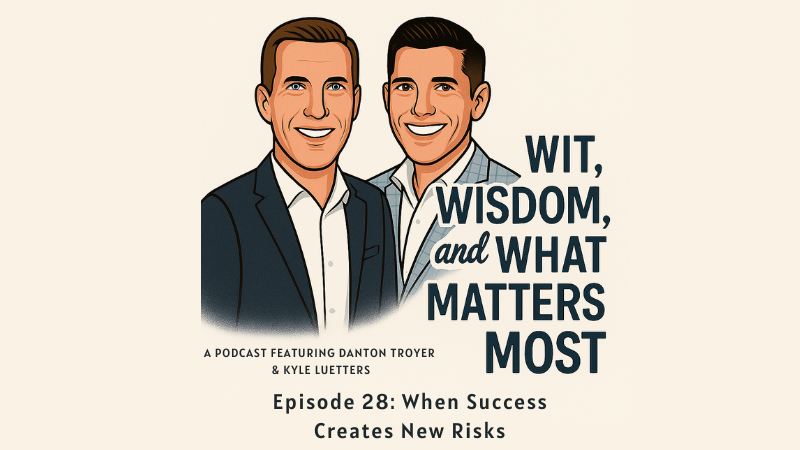
In this episode, Danton Troyer and Kyle Luetters speak with Tony Martignetti, Founder and Chief Illumination Officer of Inspired Purpose Partners, about reducing founder dependency and preparing a business for leadership transitions. Tony explains why succession planning should begin before an owner is ready to leave, how key-person risk can affect an eventual sale, and where AI can support executive decision-making without replacing human judgment. He also explores C-suite trust, emotional capital, executive burnout and boreout, and how a leader’s behavior can influence the entire organization.
Key Takeaways:
- How founder dependency can affect business continuity, company value, and preparation for a future sale
- Why succession planning should begin well before a founder, CEO, or business owner plans to step away
- How executives can use AI to test their thinking without giving up their judgment, voice, or identity
- Why trust, emotional capital, and honest conversations can strengthen C-suite relationships
- How executive burnout, boreout, and changes in leadership behavior can affect the wider organization
- And more!
Connect With Danton Troyer:
- Moneta Group
- LinkedIn: Danton Troyer
- dtroyer@monetagroup.com
- (314) 735-9087
Connect with Kyle Luetters:
- Moneta Group
- LinkedIn: Kyle Luetters
- kluetters@monetagroup.com
- (314) 536-8297
Transcript
Intro: [00:00:00] Welcome to Wit, Wisdom, and What Matters Most with Danton Troyer and Kyle Luetters from Moneta Wealth Management. In this podcast, we help corporate executives and business leaders navigate the real-life uncertainty around new financial life stages, from complex benefits and career changes to retirement and legacy planning.
Join us as we explore these career and life-shaping moments with our guests, helping listeners find clarity so they can focus on what matters most to them
Kyle Luetters: And welcome to another edition of Wit, Wisdom, and What Matters Most. It’s a podcast with Moneta’s Gast Freeman Troyer team. My name is Kyle Luetters, joined alongside Danton Troyer. And Danton, a very, very special guest today. You wanna kinda give our listeners a little bit of a preview who we’re gonna be talking to today?
Danton Troyer: Yeah, certainly. And I won’t take all the thunder, Tony, but this, we have Tony Martignetti on our podcast today, and he’s provided guidance in [00:01:00] and some coaching in the executive realm. And so we really wanna get his perspective on what he’s seen and what’s worked well. And so today we’re gonna be talking about when success creates new risk.
But before we get into that, Tony, I wanna give you a minute, just give us the details. I know you’ve got a pretty interesting background, so I wanna make sure you get an opportunity to share that.
Tony Martignetti: Yeah. It’s been quite a journey. I’ve spent 25 years working in the trenches in finance and strategy in the biotech and high-tech industry before making the leap into the world of leadership development and leadership advisory in Inspired Purpose Partners.
I’ve written now three books. My third book’s coming out in the fall of 2026. It’s called Illuminating Hidden Brilliance. And I love the work I do now. It’s been quite a journey, but all worth it.
Danton Troyer: Yeah. Three books. That’s pretty impressive on its own and then everything else. One of the things we wanna talk about today is when success creates new risk, and I would say personally you’ve had success as well, and so maybe sharing some of those stories, but [00:02:00] also the folks that you’re working with and what you’ve seen.
Well, the first topic we’re talking about is why does success really increase complexity? And I think we all kind of know that big picture, but the devil’s in the details and what really starts to come out, and so we’ve talked about that a lot. But what have you seen from that perspective?
Tony Martignetti: Yeah, it’s one of those things where more money, more problems.
Though, but the reality is it’s when you are successful, what happens is it doesn’t simplify things. It becomes a multiplier ’cause you have more surface area to deal with. And with every additional dependency you have, more people are relying on you, and you’ve gotta find ways to find leverage in what you do.
And that is, when I say leverage, there’s so many elements of that. How do you find ways to do things simpler for you, but also find ways to outsource what’s really not meant for you to do? AI has been a great addition to the workforce, but be careful what you put into the AI elements. [00:03:00] You can’t let go of the things that are more, that are essentially you.
Because that’s what people are relying on. The what you do that creates the amplifying effect of who you are is essential. And so you need to make sure that you know what is it that created my success, and how do I ensure that I’m keeping that to me and not outsourcing the essential parts of who I am?
Kyle Luetters: Tony, as you start to work with folks, and this is a great thread to go down, but do you find people have some difficulty with becoming self-aware of knowing when they need to start reducing some of the things that they’re necessarily deciding on day to day? And it’s probably different for everyone, but is there like a, a certain aha moment that a lot of people reach when they realize, “Hey, I’ve gotta throttle back,” or, “I’ve gotta get myself extricated from some of these things”?
Tony Martignetti: Definitely. And I see it most of all in founders who have started a company, they see themselves as the [00:04:00] essential piece of the business. The problem is that if they don’t extract themselves from the core parts of the business, they’re gonna find themselves in a really tricky situation, especially when they go to exit.
Because when you go to exit a business and all the things start and end with you, and you try to find a way out of that, the valuations are actually starting to be connected to who you are, and that’s devaluing because they can’t extract you out of the business. And so you need to be thinking about, “What am I doing day in and day out, and how do I process and start documenting the things that I’m doing so that I’m ensuring that long-term I’m finding people who can start to bring…I can start to outsource to them the things that are important, but not necessarily essentially me?”
Now, eventually, as I don’t wanna be contradicting myself here. You wanna make sure that you’re still adding value in your own [00:05:00] way, but when the time comes for you to step away, you have somebody lined up to be a great successor for that business.
Danton Troyer: One of the things you touched on there, kind of both sides of the AI piece and making sure that how…It’s fairly new to the marketplace, but what are you seeing as far as, especially leadership, where maybe you do wanna take some of that and then shift it toward AI, for example, to help with some of those tasks, but you still want it to be you? And so have you seen maybe some successes in doing that? But I’ve got some failures as well I’ve seen as well.
But what have you seen as far as really good leadership starting to use AI to just branch out?
Tony Martignetti: Yeah. One of the best ways I’ve seen this happen, and it’s not just about the individual, it’s actually teams, is when I work with teams and use AI, I say, “Look, invite AI into the room. Let it be part of the conversation, but don’t just abdicate all of the, ‘Okay, what should we do?’
Or, what is it, what are the notes?” I let it be the [00:06:00] empty chair. “What did we miss?” There’s the old analogy of the stakeholder that wasn’t there, but how do you let AI be the one that, what did we not have in the room that needs to be said? What wasn’t said?
Danton Troyer Yeah.
Tony Martignetti: And the same thing goes true for the individual.
Don’t let AI be the, “Oh, you’re so great,” type of conversation. Let it be the one that says, “Look, what am I missing? What is the thing that I’m not saying that needs to be said?” And let it challenge you. In fact, train your AI to be confrontational with you. Because you keep on-
Kyle Luetters: Wonderful .. I’m gonna have more people argue with me
Tony Martignetti:…letting it be like-“Oh, you’re great.”
Danton Troyer: Yeah, no, I agree. I mean, I feel like a lot of times they just reiterate what you said and take you down that path. And I found myself saying, “No, I want you to give me the contradictory.”
Especially in this day of social media, you’re just reading something and you’re like, “Is that true or not?” And I’m like, “Tell me the reasons it’s not true and the reasons it is true,” ’cause nothing’s… I say nothing. Most things aren’t black and white these days as well. So that, I love that analogy. That’s [00:07:00] great.
Kyle Luetters: I wanna shift gears just a second, kind of talk about the human element thing. You mentioned successor.
Tony Martignetti: Yeah.
Kyle Luetters: And so in leadership, especially with founders, folks that are in the C-suite in businesses, how soon do you typically work with people on identifying that next person, that next key component to what’s going on with the business or the organization? We always hear start sooner rather than later, but typically, what are you finding is an applicable runway for having that person ready?
Tony Martignetti: It really does depend on the nature of the business. There are some businesses where turnover is happening so rapidly that you almost wanna be starting from day one. And I guess that is really the best way to think about it. How do I, first of all, understand the nature of what I’m in right now, but also think what’s on the horizon?
Because things [00:08:00] do happen so quickly these days that we need to be ready for just about anything. So I would say the earlier the better. I’m not gonna say, oh, it should be three weeks after you get into the job- … or three months. But I would definitely, don’t be too slow to plan for that, because you find yourself in a situation where a medical situation or just accidents happen, things happen.
You wanna be having a plan so that you don’t have your business falter and create a path that just is not tenable. Because think about all the people relying on you, not just your customers, your employees, all the people who are the stakeholders who are in the room that, or the ones that aren’t in the room, who are gonna be relying on where your business is adding value.
So it’s almost great to have that insurance in your back pocket to know that I’ve got people here who if I had to step away for an extended period [00:09:00] of time – or forever- could step in and do the work.
Danton Troyer: So as you’re seeing folks progress through this from startup to, I don’t wanna say unsuccessful, as they’re experiencing more and more success, are there things like certain risks you’re seeing that are starting to maybe creep in that maybe you don’t see right away, maybe until it’s too late?
Are there things that you’re seeing that kind of change as you do get more and more successful?
Tony Martignetti: Absolutely. When I think about the risks that are on the horizon, let’s start with the geopolitical risks. There’s a lot of political risks that, you know, as you go into new countries, not that every company that I work with is global, but there’s always the idea that if you’re taking a product globally, you’ve gotta think about, where are my products being made? Where are the, where’s the supply chain being managed?
Because the moment something happens and you’ve got a kink in the armor, you’ve gotta figure out how you’re going to pivot when that happens. [00:10:00] So there’s a supply chain risk, there’s the political risk, there’s the AI risk, which definitely is something that you wanna manage and not do it in a way that’s going to put you having a situation where you’re letting people go, and then you’re like, “I gotta hire people back.”
Danton Troyer: Yeah.
Tony Martignetti: And then you’re having that PR risk, which is “How do I make sure that whatever move I make is going to be viewed in a way that the public will understand what I’m trying to do and how I’m doing it.”
Not that you have to appease every person and every stakeholder in the right way. I always come back to some of the biotech leaders I worked with who would always be worried about, “okay, if a patient dies, what happens? Or if a clinical trial fails, how are people gonna view it?”
Sometimes you have to educate people too, to let them know that, look, you need to understand the business fundamentals of how this works, and that’s important too. Don’t necessarily [00:11:00] go on the whims of everything that happens externally and panic.
Instead, understand how to educate people around you about what is important.
Kyle Luetters: We talk about risks to leadership, and one of the things I have always found, whether it’s people I’ve followed or studying others, Curt Cignetti comes to mind at the moment Describe the role of authenticity in leadership, because I think that’s a huge element when you’re trying to influence and follow people. So if you could just touch on that a little bit and what you’ve seen.
Tony Martignetti: Yeah. Such a great topic, and one that is constantly in the news. People say, “Look, authentic doesn’t mean I have to be putting all of my dirty laundry out in the open,” and that’s not what we’re advocating for.
And I’m a big proponent for being authentic…but authentically in a way that serves others. And that means inside and out. If you’re gonna be authentic, don’t go out there and tell people all of the things that are happening in your [00:12:00] inside world and the drama at home or what have you. But do something like tell people what you believe, and let that belief be something that’s gonna serve the people who are going to be operating with you.
What you don’t know and how you’re going to mitigate that risk, if you will, or the things that are, that you’re not aware of, but you’re doing something to actually move anyway in that direction.
‘Cause people will get behind you when they feel like you’re, there’s confidence behind the humility. Does that make sense?
Danton Troyer: Yeah. Absolutely. So we’re talking about teams and obviously you work with a lot of executives, and that’s how we met, is working with executives, but in different ways.
Tony Martignetti: Yeah.
Danton Troyer: If you’re an executive, and we just talked about all these different risks, and you’re building a team around you, what’s the – maybe not best – but what is a way to that coordination amongst all these folks that can bring value to you?
Does that reduce your risk, and how have you seen that actually come into [00:13:00] play in real life?
Tony Martignetti: Yeah, and now you’re getting, we’re getting really juicy here- … because this is something at the core of why I think it’s so important.
Danton Troyer: Yes.
Tony Martignetti: There’s two things that I love doing with teams. I like to get them to really explore the parts of themselves that they don’t necessarily bring in the room, and do it together.
Because there’s a sense of bringing the identity of who I really am, but doing it with others, allows them to connect more deeply. Because when they allow themselves to see each other, they can then find ways to get each other’s back, and to move forward more productively.
Whereas if they close off with each other, the C-suite is moving in a way that says, “Okay, I’m gonna protect my own,” or put a boundary up, then ultimately what’s gonna happen when the chips fall and things are in a challenging time, it’s gonna be a situation where everyone’s gonna be land-grabbing or doing things that are gonna protect their area, [00:14:00] and that’s unhealthy.
You need to make sure that team is united. But in order to be united, they have to be connected and truly understand who’s at the table.
Kyle Luetters: We talk an awful lot about how important culture is, and team building’s extremely important, and that happens over a long period of time. However, sometimes we don’t have runway to galvanize everybody.
Is there anything that in your research and in your time, Tony, that you’ve realized that for leaders out there, for C-suites, if I need a real quick shot, almost of penicillin- … for this team building aspect, what are some quick things that you’ve noticed over time that great effective leaders do to circle the wagons, gather the troops together in a quick way to triage a situation while we work on the long term?
Tony Martignetti: Yeah. There’s a couple of questions I often ask people, and get them to ask their people too, which is to say, “What is lighting you up these days? What are the things that are giving you the most hope [00:15:00] at this moment?” That’s the first question.
And then the other one is, “What is the thing that’s really challenging you?” You want people to feel comfortable and safe to be able to bring their risks to the table. Because if they’re not gonna bring that openness in, then you’re gonna have people clamming up, not really sharing. And then you’re gonna be stuck because you’re not gonna hear the truth from the people around you. So that’s the second question.
And the third thing is, “If you were the one who’s making the decision today to lead us forward, what would you do? What is the thing that you want to see us do next?”
So three simple questions, but obviously there’s a lot of really deep understanding that comes from them.
Danton Troyer: Yeah, I love those questions. I just had lunch with one of the people on our team today that I hadn’t spent enough… he’s new, so I hadn’t spent enough time with him, and I think that is a point.
And too, at some point we’re gonna have a pretty big market correction or whatever. Something’s going to happen, and we’re all gonna be here probably [00:16:00] working late and dealing with stuff we don’t wanna deal with. But I think, to your point, if you’ve got that connection, it makes it a little bit easier to come to work and get those things done versus if it’s like, “Oh, I don’t even wanna spend time with this guy to begin with,” it’s just not enjoyable and it’s not gonna be as efficient as well.
So I love those questions. I might have to steal a couple of those.
Tony Martignetti: Oh, it’s all good. And I’ll just add one other thing. It’s like… you think about those times… I always think about this concept called conversational intelligence, which comes from a woman by the name of Judith Glaser, and her concept is that everything happens through conversations.
And there are three levels: there’s transactional, positional, and transformational.
Well, oftentimes, especially when things have to be done quickly, we have to be like, “Okay, it’s a yes or no,” or, “Just give me a quick answer.” And that’s fine when you need that, but we gotta make sure that if something’s really different, it’s a big, profound conversation, we have to give it the time and build the trust to [00:17:00] make sure that we’ve built the foundation for those things to happen.
And then when you come back to the quick, “We need a quick answer,” people are going to remember that we’ve had the deeper conversation before, and they’re not going to react like, “Wow, that was pretty rude, Danton. Why did you say it like that?” They’re not, ’cause you’ve already done the groundwork to know that they get where you’re coming from.
Make sense?
Danton Troyer: No, absolutely. I’m like, I’m in general a more direct person, so I have to make sure that I’ve done those other things, otherwise yeah, people are like, “You’re just a rude jerk.” If I don’t take time to do the other stuff, I’m like, “Yeah, I understand, but I, I don’t mean to be that way, I promise.”
Kyle Luetters: Yeah. It touches on that topic of that emotional capital, and you’re placing deposits with folks along the time, because you know at some point you will probably have to make a withdrawal of some sort. Danton mentions where we have a… I’m thinking back to this, we’re recording this in 2026. In the [00:18:00] spring of 2025, things went sideways in, in a hand basket. I won’t use another word, because even though this is a podcast, I don’t want anybody to bleep anything.
You did have to lean on people, and I think, that’s a hallmark of good leaders. They realize that in certain situations they are gonna have to lean on people, and it may not be the most pleasant thing, but to your point, Tony, and what Danton was describing too, you’ve made enough of those deposits over time that when it comes time to make a withdrawal, you’re not, you’re basically not drawing the account into the red.
And in the red with people is a big problem.
Danton Troyer: Yeah.
Tony Martignetti: Yeah.
Danton Troyer: Yeah, that’s when we start losing people.
Tony Martignetti: Especially in those tense times, right?
Kyle Luetters: Correct.
Tony Martignetti: If you’re just coming in red hot, and you’ve never, and you haven’t built the foundation, haven’t built the social capital, emotional capita,l beforehand, then what’s happening is people are like, “Yeah, you know what you can do. You’re nuts. You can go away.”
Kyle Luetters: What do you find, Tony, in your work, what do you find are the key hallmarks of [00:19:00] team-building activity? Because…my wife and I do premarital counseling with folks, and we often talk about how you build something together, and men and women are very different, obviously.
Men do think… if you didn’t know that, spoiler alert. But research has found men bond through activity, like shared physical activity. Women bond in a different way, and then you add a whole entire element of, hey, we work together.
So is there anything that you all have found in your research when you’re doing these books and your coaching that is good, almost kind of all-season, team-building that folks can implement?
Tony Martignetti: There’s two parts to this, and I’ll say the starting point is get people out of performative mode and into play mode.
Kyle Luetters: Okay.
Tony Martignetti: And yep, we still have to play when we’re adults, because one of the things about that is that when people are in performative mode, there’s still an element of competing and wanting to be perfect, and we’re not really in the mode where we’re allowing ourselves [00:20:00] to be a beginner again.
But when you drop that and you get into play, what happens is you’re willing to screw things up. You’re willing to see what happens in doing it together.
And so the move I often make, and this is where I do a lot of art-based activities with people, the moment I say it, people have panicked, ’cause they’re like, “Oh, my God, we’re gonna do that?” And the level of experience varies. Some people haven’t touched a pencil or a crayon or any of those markers since they were kids. And that’s okay. We’re not looking for people to be artists. What we want them to do is to just get themselves out of their head and just drop into their heart and just play with each other and see what comes out.
And through that, a lot of things happen. Some things that they never thought of show up, and they’re in conversation with each other on another level. So I think that is one of the most fundamental [00:21:00] moves I love doing with people in a team-building activity because it allows them to communicate in a way that they haven’t before
Danton Troyer: Yeah, I like that.
I do it not because I thought of it that well as you just said, but we do, we try to do team events that are fun. And to your point now that you’ve said that, it’s oh yeah, we do have really good conversations in those moments that you’re just not gonna have at the office. It helps solidify we’re gonna have to do another team event here shortly. So everybody’ll be happy about that.
Kyle Luetters: There’s a big difference-
Danton Troyer: Yeah.
Kyle Luetters: Yeah. There, there’s a big difference between drawing something or getting out of an escape room together … versus, you know, this is… So there’s a lot of validity to that. Yeah.
What do you see as some warning signs? I know we’ve kinda had a wide ranging conversation here, Tony, but what are some warning signs that internally for leaders, they need to pay attention to? Because when we all get on an airplane, they tell us to secure our masks first in the loss of cabin pressure. So if leaders aren’t taking care of themselves, that can, to your point earlier in [00:22:00] the conversation, have ripple effects across the organization. But what are some warning signs that you see a lot of in leaders they don’t recognize until maybe it’s too late?
Tony Martignetti: I always think about the first two signs are, they’re really important for them personally, and that’s burnout and boreout. And burnout has so many different ways of showing up. You’re just going through your days and just feeling like, oh gosh, this is just not sustainable and I’m not even looking forward to going in the next day, or I’m finding myself just going through the motions.
And boreout is one that you don’t often see expressed in this way, but you’re doing great work, but your heart isn’t in it. Your spark’s gone and you’re just, yeah, whatever. It’s just another activity, another thing, and you’re just, you’re not really giving it your all.
Kyle Luetters: Yeah.
Tony Martignetti: And so I’m always trying to challenge people to say, “When was the last time you felt fully alive in your work? Or when you felt fully alive in your life?”
And try to find that kernel [00:23:00] of the spark so we can reignite it, get it back into the game. And when you do that, how can you invite other people to do that same thing? In my book, my next book that’s coming out in the fall, I talk about this idea of being the lighthouse.
The lighthouse is not about burning the brightest. It’s about guiding other people in, but also being sustaining. And I think that’s where we need to be careful. How are you sustaining your light, first and foremost, and then allowing other people, guiding other people into that and helping them to sustain it?
And so I think that’s a key part of it. But also, when you think about the people around you, when you start not hearing as much from them, and then when you do hear from them, it’s mostly negative…well, maybe it’s time for you to do a check-in and say, “What’s working? What’s not working?” The trying to find out, get a pulse of what’s truly going on.
And one last thing, guys, I know I’m rambling, but-
Kyle Luetters: No, I like it …
Tony Martignetti: …keeping in mind that you are the thermostat [00:24:00] for that room, and you wanna make sure that you’re setting the temperature appropriately. ‘Cause if you show up and you’re constantly low and head drawn down, then people are gonna follow that.
They’re gonna be like, “Oh, if he’s checked out, then maybe I should be checked out, too.” Or if you are constantly on fire and constantly yelling, then guess what? You’re gonna get yelling back.
Danton Troyer: Yeah, right. Yeah.
Tony Martignetti: So remember, you set the temperature. Be the temperature that you want.
Danton Troyer: All right, that was leading to the next.
What are the things you can, before you get to that point, are there things you can proactively be doing to make sure you are setting the right tone? ‘Cause you go day-to-day, and it can be hard to step back and be like, “Oh, yeah, I haven’t said anything to my staff,” or, “I haven’t talked to anybody, I just kinda go through the motions.”
That you’ve been doing that for months, years. You just don’t think about it. So is there things you can do to proactively make sure you’re staying on that path that we all wanna be on? [00:25:00]
Tony Martignetti: Yeah. Absolutely.
Danton Troyer: Yeah.
Kyle Luetters: Tony, we’ve mentioned a lot of things in this time period. There’s a wealth of knowledge that you have, and you continue to mine and dig deeper.
If folks wanted to learn more about your work, they wanted to pick up some of your books, where can they find you? Where is the best place to connect with all things Tony?
Tony Martignetti: Okay, I’m gonna give you two spots. Number one is my website, which is tonymspeaks.com. Of course, with my last name, you just can’t get the full last name.
It’s just too much.
Kyle Luetters: Yeah. Yep. Completely get it.
Tony Martignetti: And then the other spot would be to go to LinkedIn. That’s where…my home ground. I get a lot of activity there, and I share a lot of insights, always in this, with the intention of helping people to add value and that’s all I’m there for. And my LinkedIn is Tony Martinetti, with a, a one at the end, not an I.
Kyle Luetters: Very cool. Very cool. I love that.
Danton, and also too, speaking of where you find things, [00:26:00] where can folks find us as far as this podcast and other things Danton and Kyle?
Danton Troyer: Yeah, our podcast has its own site, witwisdomandwhatmattersmost.com. Probably the easiest way to find us, and, and similar to Tony, we operate on LinkedIn, and at monetagroup.com as well if you need us professionally as well. Those are probably the easiest ways to reach us.
Kyle Luetters: Tony, we, on behalf of Danton and myself and the entire staff here behind the scenes, wanna say thank you very much. Yeah. Folks will not know the scheduling perils that we went through. This has been a highly anticipated podcast. But we’re so grateful that you made some time for us today, so we appreciate it very much, and amazing to learn more about your story.
Danton Troyer: Yeah.
Appreciate it.
Tony Martignetti: Very grateful. Thank you.
Kyle Luetters: All right, folks. That was another edition of Wit, Wisdom, and What Matters Most. It is a production of Moneta’s Gast Freeman Troyer team, headquartered in St. Louis, Missouri.
Until next time, enjoy what matters most.
Outro: Thank you for listening to the Wit, Wisdom, and What [00:27:00] Matters Most podcast. Click the follow button to be notified when new episodes become available. Visit our website at witwisdomandwhatmattersmost.com to learn more and find additional ways to connect with us in the show notes.
The opinions voiced in this podcast are for general information only and are not intended to provide specific advice or recommendations for any individual. To determine which strategies or investments may be suitable for you, consult the appropriate qualified professional before making a decision.
Investment advisory services offered by Moneta Group Investment Advisors LLC, an investment advisor registered with the Securities and Exchange Commission. Registration does not imply a certain level of skill or training. The information discussed in this podcast is for informational and educational purposes only and represents the views and opinions of the guest and/or host and does not necessarily represent the views and opinions of Moneta.
You should consult with an appropriately credentialed professional before making any financial, investment, tax or legal decision. Past performance is not indicative of future returns. All investments are subject [00:28:00] to risk of loss. Please see disclosure for additional information.
© 2026 Advisory services offered by Moneta Group Investment Advisors, LLC, 190 Carondelet Plaza, Suite 1200, St. Louis, MO 63105 (“MGIA”), an investment adviser registered with the Securities and Exchange Commission (“SEC”). MGIA is a wholly owned subsidiary of Moneta Group, LLC. Registration as an investment adviser does not imply a certain level of skill or training. This is an advertisement. The information contained herein is for informational purposes only, is not intended to be comprehensive or exclusive, and is based on materials deemed reliable, but the accuracy of which has not been verified. Examples contained herein are for illustrative purposes only based on generic assumptions. Given the dynamic nature of the subject matter and the environment in which this communication was written, the information contained herein is subject to change. This is not an offer to sell or buy securities, nor does it represent any specific recommendation. You should consult with an appropriately credentialed professional before making any financial, investment, tax, or legal decision. Past performance is not indicative of future returns. You cannot invest directly in an index. All investments are subject to a risk of loss. Diversification and strategic asset allocation do not assure profit or protect against loss in declining markets. These materials do not take into consideration your personal circumstances, financial or otherwise. Trademarks and copyrights of materials linked herein are the property of their respective owners.