
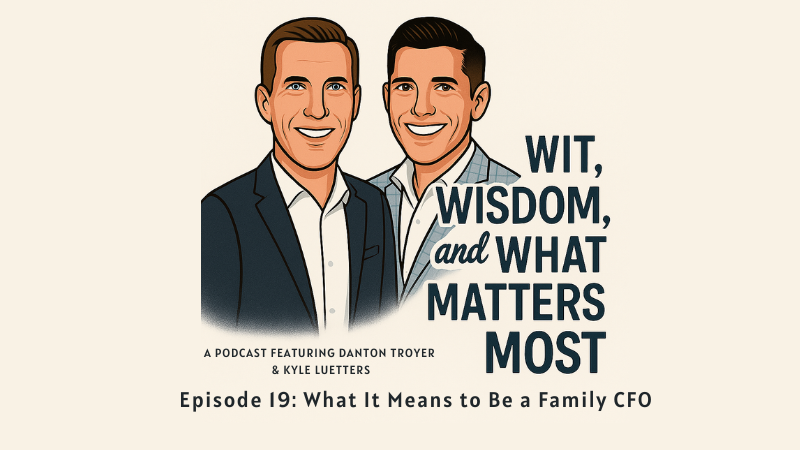
Episode Takeaways
What does it really mean for a financial advisor to act as a “Family CFO?”
In this episode of Wit, Wisdom, and What Matters Most, Danton Troyer and Kyle Luetters explain how financial planning goes far beyond investments and into the real decisions that shape a person’s life. Danton and Kyle discuss their “Family CFO” approach to financial planning and how it helps clients navigate complex financial decisions throughout different stages of life.
They explore how financial complexity often grows gradually as careers advance and compensation structures evolve. What begins as simple retirement savings can eventually include stock compensation, deferred compensation plans, tax planning strategies, and legacy considerations. Without coordination, these pieces can quickly become overwhelming.
Danton and Kyle also explain why effective financial planning begins with understanding a client’s personal goals and values. Through stories and real client experiences, they share how meaningful conversations, thoughtful questions, and long-term accountability can help clients align their financial decisions with what truly matters most.
Key Takeaways:
- The “Family CFO” approach to financial planning
- How financial complexity grows as careers advance
- Why planning starts with understanding personal goals
- The long-term ripple effects of financial decisions
- The value of accountability and guidance in financial planning
- And more!
Resources:
- Visit us at witwisdomandwhatmattersmost.com
Connect With Danton Troyer:
- GFT Team
- Moneta Group
- LinkedIn: Danton Troyer
- dtroyer@monetagroup.com
- (314) 735-9087
Connect with Kyle Luetters:
- GFT Team
- Moneta Group
- LinkedIn: Kyle Luetters
- kluetters@monetagroup.com
- (314) 536-8297
About The Hosts:
Danton Troyer brought his individual practice to Moneta in 2018, after more than a decade on his own. Adding the support of our team, backed by an Enterprise Service Team, to Danton’s personal expertise and care for his clients created quite the dynamic combination. As your Family CFO, Danton and our team deliver high-level service and advice while giving you and your personal financial circumstances the individual attention you deserve. You can trust our team to help you navigate life’s many major financial transitions while protecting your savings and assets. He excels in developing sophisticated solutions for complex tax challenges, education expenses, business ventures, philanthropy, retirement, and multigenerational legacies.
Danton earned his bachelor’s degree from Missouri State University in 2005 before moving back to St. Louis to start his career as a Financial Advisor. He then went on to earn his CFP® credentials in 2010. Danton and his wife have two children who keep them busy with all their activities, from volleyball to BMX racing. Outside the office, Danton enjoys golfing, traveling, and hunting.
Throughout his adult life, Kyle Luetters has had a passion for financial literacy and complex problem solving. Kyle has experience in investment model management, alternative investments, insurance strategies, and tax planning. He lends this expertise to a diverse client base, which includes multigenerational families, business owners, and farmers and ranchers. Kyle joined Moneta’s GFT team as an Advisor in 2022. Prior to that, Kyle was involved in financial planning and investment management at Northwestern Mutual and Stifel Nicolaus. In 2019, Kyle obtained the CERTIFIED FINANCIAL PLANNER® (CFP®) certification. Kyle earned his CFP® because of his deep love of working with people and the knowledge gained in comprehensive financial planning, ensuring he is able to deliver world-class solutions to his clients and prospects. The ongoing continuing education keeps him sharp and on top of changes in the industry. The high ethical standards set forth by the CFP® Board provides great reassurance to his clients and prospects. Kyle became an Enrolled Agent (EA) in 2024. The highest credential awarded by the Internal Revenue Service, EAs earn the privilege of representing taxpayers by passing a three-part, comprehensive test covering individual and business tax returns, as well as IRS procedures and rulings. Kyle became an EA to further his knowledge and understanding of taxes while helping people navigate their financial life as tax-efficiently as possible.
Kyle graduated from Cameron University with a Bachelor of Arts degree in communications. Kyle and his wife have two children. He is active in his local church, participates in a men’s organization called F3, and is an active do-it-yourselfer. He also enjoys craft beer, motorsports, wood-fired BBQ, and is a proud Kansas City Chiefs fan.
Transcript
Intro: Welcome to Wit, Wisdom, and What Matters Most with Danton Troyer and Kyle Luetters from Moneta Wealth Management. In this podcast, we help corporate executives and business leaders navigate the real life uncertainty around new financial life stages from complex benefits and career changes to retirement and legacy planning.
[00:00:21] Intro: Join us as we explore these career and life-shaping moments with our guests, helping listeners find clarity so they can focus on what matters most to them.
[00:00:32] RJ Malyk: Hello and welcome to Wit, Wisdom, and What Matters Most podcast with your hosts, Danton Troyer and Kyle Luetters. I’m your podcast producer, RJ Malick. Danton, and Kyle,
[00:00:42] RJ Malyk: Good to see you again. Looking forward to your next podcast, uh, as we, this is basically number two that we’re working together. So I’m, uh, uh, pretty, pretty excited about this. And what are we gonna be discussing on this podcast as we move on to your next one? [00:01:00]
[00:01:00] Danton Troyer: Yeah. We’re gonna be talking about, you know, we use the term around here, a Family CFO, but, okay.
[00:01:06] Danton Troyer: I think that can mean different things to different people. I know there’s probably different firms that also use that. So, you know, what does that mean to us and how do we Right,present ourselves as Family CFO.
[00:01:14] RJ Malyk: Okay. So what does that mean to you, Danton? We’ll go with you first.
[00:01:18] Danton Troyer: Yeah, yeah. Um, you know, and for us, I mean, again, coming from outside of Moneta.
[00:01:24] Danton Troyer: I think every advisor out there, no one’s out there saying, you know, I don’t do tax planning, I don’t do comprehensive, you know, financial planning. We all, we all say we do the same thing, but through reality is, and we all know that there are differences. And so, you know, the Family CFO to us is a way to encompass really everything.
[00:01:40] Danton Troyer: And so when we’re working with clients, I mean, someone maybe don’t believe us, but you know, we do a lot for our clients that are maybe outside of, you know, what traditional advisors say is their scope. Um, so anything that has to do with their financial lives, we truly want to help them with. And we wanna understand that.
[00:01:57] Danton Troyer: And also, you know, how does that affect everything else? [00:02:00] And so the Family CFO is simply, that is, you know, they are still the CEO of their lives. We are simply the financial, uh, officer that’s able to help them make good financial decisions so they can run their lives and, you know, focus on, you know, not to steal from the pilots,
[00:02:14] Danton Troyer: You know, what matters most.
[00:02:15] RJ Malyk: Uh, Kyle, your take?
[00:02:17] Kyle Luetters: To Danton’s point, like I think every professional that gets into this industry desires and aspires to take care of everything in their client’s financial lives that has a dollar sign. And that’s really to me, what Family CFO means if it has a dollar sign next to it,
[00:02:34] Kyle Luetters: if that decision involves money, we want to have a say in the table, and that means way more than just investments, insurance…it’s workplace benefits, equity, compensation. If you still have a mortgage, you know, we pick up the phone and say, Hey look, we know that you’ve got this interest rate on your mortgage.
[00:02:50] Kyle Luetters: You should probably refinance. Or, let’s take a look at this. To Danton’s point, if you look at an organization, the CEO usually [00:03:00] casts vision for the company as a whole. Their purview’s over operations, people, finance, so on and so forth. Our CFO role is very similar to that, what you would see in a lot of our clients’ businesses, in fact, some of them actually might be CFOs of businesses, but
[00:03:15] Kyle Luetters: you need a bit of objectivity, and that’s what A CFO brings to C-A-C-E-O is a background knowledge in the numbers, because money, at the end of the day, is ultimately a tool, and it’s how we’re going to apply it in a set/series of parameters to achieve a goal. So if the client’s the CEO, we’re the CFO.
[00:03:36] Kyle Luetters: We’re telling you, look, based on the numbers, here we go. What do you want to do? And then we need to figure out a way to get the numbers to align with the vision for the overall thing.
[00:03:47] RJ Malyk: But as CFO for different clients, you have to really know their backgrounds because you don’t have a one one-size-fits-all because that would, that would not [00:04:00] work.
[00:04:00] RJ Malyk: So what kind of process do you go through to sort of get the lay of the land so you can give them the right plan?
[00:04:09] Danton Troyer: Yeah. I think one of the biggest things, we just have less relationships at the team level. Meaning that, you know, or I started my career, I had 400 families I was working with. Impossible. I, I mean, you literally couldn’t know every single one of ’em.
[00:04:22] Danton Troyer: It’s just not, your brain can’t handle that, you know? Now we’re closer to, you know, a hundred. You can really get to know a hundred families pretty good and really understand what they’re trying to accomplish. And, and so then the money just, you know, you know, hopefully is filling in those, those holes or you know, what they’re trying to accomplish.
[00:04:40] Danton Troyer: But yeah, we need to start with understanding what are you trying to accomplish? And, you know, I’ve had folks push back. I remember one guy years ago, he was like, I don’t need a financial plan. It’s like, it’s, it’s all garbage anyways. Like it’s never gonna happen. And I was like, yeah, you’re probably right, actually.
[00:04:55] Danton Troyer: Like none of this today is actually gonna happen. But if we don’t start with something, [00:05:00] you’re just aimlessly kind of wandering through life and you know, I see that as myself as well. I mean, I didn’t expect where I was gonna be, you know, 10 years ago to be sitting here doing a podcast, obviously. But the reality is like, I’m happy I’m here and if I didn’t have a plan of the higher, you know, arching goals that I was trying to accomplish, I wouldn’t be doing this.
[00:05:16] Danton Troyer: So I think that is how people focus on, you know, life as well and why the planning really makes sense.
[00:05:23] Kyle Luetters: When that question usually comes my way, I will ask somebody, do you go to the gym? And you’ll get a varying level of answer of either yes, no…I said, do you keep yourself going to the gym? Well, usually it’s a struggle.
[00:05:37] Kyle Luetters: Same thing with your finances, by the way. It’s a very personal thing, like your health. And if you don’t have somebody that’s coming around with the latest research on how to do this effectively and efficiently, and really someone that’s gonna help you track your progress and hold you accountable to Danton’s point, you’re gonna kind of wander aimlessly.
[00:05:57] Kyle Luetters: You’re gonna maybe do a deadlift here, get on the [00:06:00] StairMaster there, but you haven’t put the complete package together because if you have a goal of X, the prescribed level of diet and exercise is different than if you have a different one. There are general truths that work in both of these examples, but if you really want to get to the nitty gritty, if you’re really trying to.
[00:06:18] Kyle Luetters: train for a marathon or train for a power lifting competition there are core things that are common for both, but I’ll be honest with you, I’ve trained for both. It was completely different, and I needed an expert in each area that was taking a look at the whole picture to get me to where I wanted to go.
[00:06:35] RJ Malyk: It was brought up about how a person would say, well, I don’t need a financial planner. I mean, how difficult is it sometimes to talk to people about their money situation? Because that’s a personal thing and it can be quite awkward at times. I mean, hell, uh, between my wife and I, we have some awkward conversations about finances.
[00:06:57] RJ Malyk: So now you’re dealing with, you know, a client. How [00:07:00] do you approach that Danton?
[00:07:01] Danton Troyer: Yeah, I, I guess, you know, maybe similar to this podcast, you know, I was a little nervous going through it, but, you know, I’ve been asking financial questions for 20 years. So for me, like to talk about finances isn’t a big deal, but maybe the problem is that maybe I’m a little too comfortable sometimes.
[00:07:16] Danton Troyer: I mean, so, you know, I’ll be at a party asking people how much they make, uh, not appropriate by the way. Uh, but you know, that’s just, you know, you know, asking somebody for their, you know, their social security number. That’s, I mean, that’s what we do all day, every day, so. I’m very comfortable having those conversations.
[00:07:29] Danton Troyer: So for me it’s secondhand, but I also understand for most people it’s not, and so that’s what, for me, especially in those meetings, is understanding that I may be making you feel a little bit uncomfortable by asking those difficult questions, but I think sometimes that’s a good thing. I mean, if you’re not stopping and talking about, you know, those difficult questions, why?
[00:07:47] Danton Troyer: I mean, because you can’t, you can’t hide from ’em forever. I mean, you know, some folks will say, well, I haven’t thought about what I’m gonna retire. Like, well, at some points that decision’s gonna get made for you, so let’s talk about it and come up with, you know, some ideas of what would work for you. So I think, [00:08:00] you know, avoiding those difficult questions isn’t the answer either.
[00:08:02] Danton Troyer: So we just gotta have ’em.
[00:08:06] Kyle Luetters: If somebody says to me, I don’t need a financial advisor, I smile and say, that’s really cool. Do you have a doctor or a dentist? Some people say, well, I don’t need a doctor. I don’t need a dentist. I say, what happens? You don’t go to the doctor or the dentist for a while. It eventually catches up with you
[00:08:25] Kyle Luetters: right? There are things in our lives that we simply do not have the time, talent, or treasure to be experts in, and, and we offload those services. Full disclosure, I have, with my wife, a financial advisor. I have a one of me for our picture. Why? Because I like shiny things, tools, and barbecue smokers. That gentleman knows what my wife and i’s long-term goals are, and he’s there to keep us accountable.
[00:08:55] Kyle Luetters: I have the technical knowledge. It’s not so much that for me it is the [00:09:00] accountability of someone saying, Hey Einstein, you and your wife agreed to Ggetting to this point, what your behavior today, short-term, is not aligning with the long-term side of things. You could do whatever you want. I don’t care.
[00:09:12] Kyle Luetters: It’s not, you know, really my future to have to deal with, but it’s just having that person in place that is constantly giving you an objective opinion based on what you said you wanted to do, and we figure out how people or what people wanna do vary aligned in the discovery process. A lot of our first meeting is not, Hey, how much do you make?
[00:09:33] Kyle Luetters: What was your tax refund? Or what did you owe last year? Who’s this person in your estate plan documents? It’s not that. It’s tell us, tell us what the dream is. Tell us what the big overarching goal is. Tell us if you could wave a magic wand. And I like to use the, the analogy of ama uh, of Mona Lisa. If you’re over here painting your financial Mona Lisa, what do you want it to look like?
[00:09:55] Kyle Luetters: And it’s going to co, it’s going to color in more so as time goes on, [00:10:00] but buddy, we gotta put the paintbrush on the canvas. We gotta start somewhere. So help us understand. Really that first meeting is very light on actual numbers and more about dreaming and concepts. And then to Danton’s point, we keep track of those things over the course of the years, every time that we meet with clients.
[00:10:17] Kyle Luetters: How’s your family doing? Have you taken that trip? Grandkids? For a lot of our executive clients now, as they start to get to a certain point in their career, grandkids start to factor in. By the way, you really want to get people to light up, get them talking about their grandkids, and some of them will even tell you if they’d known how great grandkids were gonna be, they would’ve been nicer to
[00:10:37] Kyle Luetters: they’re kids. ’cause that’s where they got ’em from. So that’s part of what goes into these conversations is it’s so much more – it’s funny to me that we’re in an industry where we talk so much about a certain topic, but it’s not the most important thing that we talk about.
[00:10:53] RJ Malyk: Okay, so you’re talking like a timeline.
[00:10:56] RJ Malyk: Mm-hmm. And it’s been very general, but when does it start to [00:11:00] get complex? When does the financial complexity start?
[00:11:03] Danton Troyer: I think in, you know, the, it’s different for everybody. I mean, certainly, you know, there’s no age where you can say, oh, when you’re 35, that’s the timeframe. I mean, and so that’s the difficulty as well.
[00:11:13] Danton Troyer: ’cause
[00:11:13] RJ Malyk: it’s, It’s situations, right?
[00:11:14] Danton Troyer: Correct. Yeah, yeah, yeah. So, you know, because going back, you know, we were talking about Moderna, you know, some of those guys, I, I call ’em kids, sometimes I mean, they were in their thirties when this was happening, and they were from their emotional side, they were going from a net worth of $2 million, which is amazing at that age.
[00:11:30] Danton Troyer: I mean, everybody would love to have that at that age to sometimes $10 million. Then back down to $2 million. And so to ride that rollercoaster at such a young age was certainly transformational. So to say, certainly age, but you know, there’s just the, I think once you get to that level at a company where you are starting to receive, you know, variable compensation, you know, you’ve got different benefits packages that maybe, you know, the, the rank and file employees where, you know, you may just have a 401k when you get started, you, you put some money in it,
[00:11:57] Danton Troyer: that’s, that’s pretty simple. But then you add something else. [00:12:00] I don’t know that there’s a, a trigger necessarily, but you know, then it’s like, you know, then you’ve got deferred compensation. You’re like, okay, I got this. And then you’re like, but then there’s restricted stock units, and then oh, by the way, you’re still running like a whole company.
[00:12:12] Danton Troyer: So I think that that’s, it’s not like a, a, a moment in time, but it just slowly creeps up on people. I think that’s maybe the difficulty for us, too, in talking with folks is they may start off like, yeah, I got this. It’s fine. And then all of a sudden. They don’t, and they don’t even realize it. And so I think that’s the difficulty made from our perspective is trying to convince people they don’t always have as good a handle on ’em, maybe as they think.
[00:12:33] Kyle Luetters: I I like to, to ask folks, how many pages was your tax return last year and when you start getting into the 20, 30, 40 page tax return, i.e. it’s not like nine pages or less, you’re starting to add enough complexity and schedules and this and that. It’s. And that’s a cheeky way of asking it, but you’ve got a lot going on [00:13:00] here.
[00:13:00] Kyle Luetters: Like there’s a lot of these pieces. And the tax return I think is the perfect analogy because all of those pieces then start to talk together. And if you do something on one end of it, it’s gonna have a butterfly effect on another end of it, by the way. So if you don’t know, you know objectively, you don’t know what you’re doing when you sell your restricted stock units,
[00:13:20] Kyle Luetters: you can’t be surprised when there’s a negative impact nine months later, let’s say, because now this is all interconnected, you know, check, you know, another thing to think about too is, is that, you know, once you start making $150,-200,000 a year, I know that sounds, depending on where you’re looking at, maybe a low or a high threshold,
[00:13:39] Kyle Luetters: that’s where we typically start to find, like you’re getting into the more complex things and like the tax code starts to become a little more complex. Your investment selection becomes a little more complex. So taking a look at the tax return income numbers, also one of those, because we’ve had some clients to Danton’s point that their wealth overnight just shot, basically it [00:14:00] was a moonshot, you know?
[00:14:02] Kyle Luetters: And, and, and so how do you handle that? And there’s also an emotional complexit. to that because, RJ to your point, this is deeply personal and, and, and, and our hopes and dreams are tied to this much like a moon rocket. And if we thought it was this and now it’s this, how do I emotionally process this? We had one, we had one client last year,
[00:14:21] Kyle Luetters: blue collar guy, brick layer for his entire career, inherits more money than he’s ever contemplated out of the blue. What do you do? His entire dynamic for the rest of his life changed financially. literally overnight.
[00:14:38] RJ Malyk: So then you have to coordinate the wealth and their lifestyle. How, how, how do you, uh, how do you approach that?
[00:14:48] Kyle Luetters: Well, you know, every client we would say is different. That feels like a boilerplate answer. At the end of the day, each and every one of us as human beings, I [00:15:00] think, have hopes, dreams, and wishes. We all have that idea of what the Mona Lisa is for us,.y the way, it changes year over year. There are some folks that we have to, I would say, put the spurs to, to get them to spend some money in pursuit of that.
[00:15:17] Kyle Luetters: There’s other folks that, that we have to pull the reins back on from time to time, and at the end of the day, it’s constantly encouraging folks on this principle of you get one shot at the turnstile of life. I was talking again this weekend at a men’s leadership conference, and on the board I drew a picture of a tombstone and in a front, in a room full of guys ages 20 through 65, drawing a tombstone, putting start year on one side, and year on the other side, putting a dash in between the two and drawing a circle around it and saying, this is what matters the most – is what you did with this.
[00:15:56] Kyle Luetters: That’s really, that’s really a good analogy for a lot of our clients, too.
[00:15:59] RJ Malyk: Okay. [00:16:00] Um. Next question. How does taxes, investments, and legacy planning intersect?
[00:16:08] Danton Troyer: Ooh, uh, I, I mean, I think, you know, we’ve kind of talked about this in, in general terms, but I mean, they all, every decision you’re making is there’s gonna be another reaction on the other side of these things as well,
[00:16:19] Danton Troyer: and so I think that’s what I think most individuals are very good at figuring out, you know, I need to pay less of taxes, I do x and then like, they’re done, that’s the done with, you know, the, the thinking of finances for the day. But the reality is like, okay, so you didn’t pay, you paid less taxes today.
[00:16:35] Danton Troyer: what about 20 years from now? Like how does that planning look for you by continuing to potentially defer taxes? It sounds like a great idea. And in theory, until you think about, okay, well in retirement, that’s, that’s what I’m gonna pay on these taxes. And oh, by the way too, like my kids, my legacy, they may be paying even more in taxes.
[00:16:53] Danton Troyer: And so, you know, all these different things are gonna beinterrelated. And if I, I, I even as an individual, when Kyle said he has his own financial planner, [00:17:00] I mean, it’s because it, there’s so many different things that just are intersecting in any given decision. And just as individuals, we’re very poor at like thinking beyond, you know, the day most days.
[00:17:10] Danton Troyer: I mean, especially, you know, if you are an executive level, I mean, you’ve got a hundred other decisions that are very, very important; to think how much you’re gonna defer in your 401k. In any just given day, it’s not that important. And you’re probably right, like that day it’s not that important, but if you don’t look at it for 20 years, it became really important for you.
[00:17:27] Danton Troyer: So I think that’s the difficulty with all of this is, you know, one decision in and of itself, you’re right, it’s probably not that big of a deal, but if you continually make these decisions – or don’t make these decisions- it could have a serious impact, not only on your life, but your kids’ lives as well.
[00:17:40] Danton Troyer: And I think that’s what people don’t really underestimate.
[00:17:43] Kyle Luetters: The concept of stacking bricks really comes into play. So like if you’ve ever built a retaining wall or anything like that around your house, if you, if. Seemingly, if you lay the first row and you think that looks okay, you’re not gonna find out that it wasn’t done right or you omitted something until you [00:18:00] get six, seven, maybe eight bricks high, and to Danton’s point,
[00:18:06] Kyle Luetters: that’s where we see a lot of things kind of like come to roost. And then you gotta figure out how to correct the very bottom, the most load-bearing row of this thing, from the top. And sometimes you just can’t do it, you know, within the the, within the scope of the rules, or in this case, the laws of physics if we’re talking about the brick wall.
[00:18:26] Kyle Luetters: That’s why each and every one of these things has to be taken together and considered because to Danton’s point, there are some folks that we tell them today, look, you should do a Roth conversion and pay taxes today. Why? I, I, I wanted a big refund. No, like, ’cause you’re probably gonna keep making more money.
[00:18:45] Kyle Luetters: You’re probably gonna always be in a high tax bracket. Let’s just go ahead and pay the tax a day and get it over with and get Uncle Sam outta your life in this regard. Because we know that you’re gonna leave enough to your kids that you don’t wanna create a multigenerational tax problem [00:19:00] for them later on.
[00:19:01] Kyle Luetters: That’s where all of this stuff comes into play. And in investments with asset location, depending on what the tax code is and what we wanna inherit, we put different things in different places. The leverage lay person just is not getting into that level of detail.
[00:19:16] RJ Malyk: Well, I mean, in their defense, they’ve got a career.
[00:19:21] RJ Malyk: They’re focused on doing the best in their career and this other part, and this is why you guys have your jobs, It is, it’s, it’s difficult and it’s complex as as you’re talking about. So how do you get a person to, like myself, let’s just say myself, I’ve worked in radio my entire career. That’s what I was focused on.
[00:19:41] RJ Malyk: Radio, radio, radio, and just, you know, getting to the next station, next level, next market, whatever. How do you shift a person’s mindset who is so focused on their career to start looking at the future? How do you shift that mindset?
[00:19:54] Danton Troyer: I think it kind of depends on, you know, obviously the person, but you know, really where they are in their career as well.
[00:19:59] Danton Troyer: I [00:20:00] mean, most people even, you know, the executives just love their job, love what they’re doing. Also realize at some point, they gotta stop. Now that’s a whole other conversation of how difficult that can be. But I think at some point they start to realize that as well. And that’s when, you know, really, I mean, everybody I think, you know, is gonna have some sort of, you know, hopes and goals and, and, and dreams.
[00:20:22] Danton Troyer: And so if you start there, they can really articulate that, but then how they’re gonna get there, especially financially, becomes a little more difficult, a little more foggy. So if you just start with the, the easy questions, you know, and then start asking a little bit more about the details, the foggier it gets, the more they start to realize like, oh yeah, like I, I, there are some questions I probably haven’t thought about.
[00:20:43] Danton Troyer: I really should be thinking in this way. For most people, I feel like that’s, that’s kind of the revelation that comes through it. So, I mean, I was talking to a, a prospect the other day and yeah, I mean, we had two meetings and after the end of the meeting he was like, I haven’t thought this [00:21:00] much about that, like ever.
[00:21:02] Danton Troyer: And I was like, we’ve spent two hours together. And I was like, yeah. I mean, it’s just really just asking questions and I, I don’t have all the answers to all these questions for you right now, but together we’re gonna figure it out. And I think that’s the peace of mind and I think that’s kind of gets what people starting at least to have that conversation, even if they’ve worked with another advisor in the past, just starting to have those conversations.
[00:21:22] Danton Troyer: It really is meaningful.
[00:21:24] Kyle Luetters: I was having a conversation two to three weeks ago with a young family. Both of ’em are dentists, they’re pregnant with their third child. And the impetus for the meeting, I always like to start meeting, especially if someone’s been referred to. what, what? What warranted you to reach out at this point in time?
[00:21:40] Kyle Luetters: And the husband and wife looked at each other and they said, we are getting so much stuff in the mail that we don’t know anything about it, what it means, and there’s a lot of numbers, and now there’s some big numbers on it that we just self-realized we need help. And for a lot of people, I think there’s an inflection moment, especially when you consider [00:22:00] starting a family, starting careers,
[00:22:02] Kyle Luetters: then you get deeper into those, that you get deeper into the family, often deeper into the careers, the workload becomes a lot more. There’s just so much coming at you, and that’s where you can talk and have conversations with folks. but until they have that self-realization, the conversation’s really not that open.
[00:22:19] Kyle Luetters: We don’t sell anything. I would say we don’t sell anything. We are here as guides and, and what’s that old adage? When, when the student is ready, the master will appear. By the way, I cannot tell you that we are masters. I think that is not the right verbiage there, but we’re the people that says, um, I’m gonna help you figure out the path outta here.
[00:22:41] Kyle Luetters: I’m gonna help light the torches for the path on out of this that you’re feeling right now. And we’re gonna do it together. And more oftentimes than not, people just wanna go with a trusted guide, someone that’s been there before. Think about if you went on vacation somewhere. Let’s say you’re going to Disney World.
[00:22:58] Kyle Luetters: You find out [00:23:00] that somebody that you know, or maybe you don’t know, has been there before. You pepper ’em with questions. I’m curious, how did you do this? What was it like? I think innately, as humans, we’re always curious about that. And that’s really what we do with folks is we’re just a trusted guide.
[00:23:18] RJ Malyk: Interesting. Alright, gentlemen, we’re uh, coming to the end. Is there anything that you wanna share that, uh, you haven’t covered yet?
[00:23:28] Kyle Luetters: Personally for me, getting to come to Moneta was the manifestation of getting to do financial planning the way that I really thought it should be done. I’ve been at firms in the past where if you were caught with a client’s tax return, it, it was basically contraband. It was like having smuggled goods, so to speak, and now I can’t imagine not having, uh, certain elements of what we do from a planning standpoint. And.
[00:23:55] Kyle Luetters: one time a lady that I was prospecting said, look, uh, tell me how you’re different. I feel [00:24:00] like I could sling a bag of dead cats and hit nine of you financial planners. like, what makes you guys different? To me, it’s the Family CFO approach. It’s the holistic aspect of it. Holistics may be overused, but literally everything with a dollar sign, we’ve got eyes on and we’re helping coordinate to see how it impacts the entire plan.
[00:24:21] Kyle Luetters: So someone asks how we’re different, I would put our process and what we gather and what we know up against about anybody else, and that’s a big reason why I stay here is because of the way that we do these things, and that’s what makes it different.
[00:24:38] Danton Troyer: I mean, I’d echo that maybe with a story. I flew out to go see a client in the San Francisco area.
[00:24:44] Danton Troyer: And we were, or we, I was like, yeah, what do you guys wanna do? You know, you know, I wanna see the area. I’ve been here, but not, you know, with you. And so they took us on, uh, a hike. They’re, they’re very into nature And, and, and so they took us through a, redwood forest, and it was a beautiful hike. But at the end he’s like, [00:25:00] why are you here?
[00:25:01] Danton Troyer: And I was like, I was kind of taken aback. I was like, I just wanted to meet you. I met ’em, you know, through a, a referral and I never met them before. And, you know, we had great conversations on the, on this walk and at the end they were just like blown away that we would take the time to take a hike as our financial advisors and the redwood forest.
[00:25:18] Danton Troyer: But through that hike I learned all their preferences. I learned, you know, what makes them tick. So if I would’ve come to them with, you know, just boilerplate investment recommendations, they would look at me like I had three heads. They had a different perspective on life than I did, for example, or the next client is, and without that little just, you know, maybe an hour hike through the woods, I wouldn’t have known all these things.
[00:25:37] Danton Troyer: So you get on these Zoom calls and you know it, it seems rushed. But you know, just taking time to just listen to what. It’s important to them, it changed everything. And the way I deal with them is completely different than the next client just because of that.
[00:25:49] RJ Malyk: All right, great. And again, enjoyed talking with both of you.
[00:25:53] RJ Malyk: Contact information -how can people get in touch with you?
[00:25:56] Danton Troyer: Yeah. The easiest way is, uh, through our website, witwisdomand [00:26:00] whatmattersmost.com. Uh, that’ll lead you back to our page. And obviously, if you wanna connect with us professionally. Um, you can find us there as well, or listen to, you know, some of the other episodes we have out there.
[00:26:10] RJ Malyk: Excellent. Alright, Danton and Kyle, thank you so much. It was a pleasure; looking forward to your next podcast. And thank you for listening to today’s Wit, Wisdom, and What Matters Most Podcast. Please like, follow, and share this podcast with friends and family. Also, we ask you to rate it and leave a review because this actually helps others find the show.
[00:26:28] RJ Malyk: Until our next Wit, Wisdom, and What Matters Most Podcast, I’m RJ Malyk.
[00:26:36] Outro: Thank you for listening to the Wit, Wisdom, and What Matters Most Podcast. Click the Follow button to be notified when new episodes become available. Visit our website at Witwisdomandwhatmattersmost.com to learn more and find additional ways to connect with us in the show notes.
The opinions voiced in this podcast are for general information only and are not intended to provide specific advice or recommendations for any individual to determine which strategies or [00:27:00] investments may be suitable for you.
[00:27:01] Outro: Consult the appropriate qualified professional before making a decision. Investment advisory services offered by Moneta Group Investment Advisors, LLC, an investment advisor registered with the Securities and Exchange Commission. Registration does not imply a certain level of skill or training. The information discussed in this podcast is for informational and educational purposes only.
[00:27:21] Outro: and represents the views and opinions of the guest and or host and does not necessarily represent the views and opinions of Moneta. You should consult with an appropriately credentialed professional before making any financial investment, tax, or legal decision. Past performance is not indicative of future returns.
[00:27:36] Outro: All investments are subject to risk of loss. Please see disclosure for additional information.
Investment advisory services offered by Moneta Group Investment Advisors, LLC, an investment adviser registered with the Securities and Exchange Commission. Registration does not imply a certain level of skill or training. The information discussed in this podcast is for informational and educational purposes only. You should consult with an appropriately credentialed professional before making any financial, investment, tax, or legal decision.
© 2026 Advisory services offered by Moneta Group Investment Advisors, LLC, 190 Carondelet Plaza, Suite 1200, St. Louis, MO 63105 (“MGIA”), an investment adviser registered with the Securities and Exchange Commission (“SEC”). MGIA is a wholly owned subsidiary of Moneta Group, LLC. Registration as an investment adviser does not imply a certain level of skill or training. This is an advertisement. The information contained herein is for informational purposes only, is not intended to be comprehensive or exclusive, and is based on materials deemed reliable, but the accuracy of which has not been verified. Examples contained herein are for illustrative purposes only based on generic assumptions. Given the dynamic nature of the subject matter and the environment in which this communication was written, the information contained herein is subject to change. This is not an offer to sell or buy securities, nor does it represent any specific recommendation. You should consult with an appropriately credentialed professional before making any financial, investment, tax, or legal decision. Past performance is not indicative of future returns. You cannot invest directly in an index. All investments are subject to a risk of loss. Diversification and strategic asset allocation do not assure profit or protect against loss in declining markets. These materials do not take into consideration your personal circumstances, financial or otherwise. Trademarks and copyrights of materials linked herein are the property of their respective owners.



© 2025 Advisory services offered by Moneta Group Investment Advisors, LLC, 100 South Brentwood Blvd., St. Louis, MO 63105 (“MGIA”), an investment adviser registered with the Securities and Exchange Commission (“SEC”). MGIA is a wholly owned subsidiary of Moneta Group, LLC. Registration as an investment adviser does not imply a certain level of skill or training. This is an advertisement. The information contained herein is for informational purposes only, is not intended to be comprehensive or exclusive, and is based on materials deemed reliable, but the accuracy of which has not been verified. Examples contained herein are for illustrative purposes only based on generic assumptions. Given the dynamic nature of the subject matter and the environment in which this communication was written, the information contained herein is subject to change. This is not an offer to sell or buy securities, nor does it represent any specific recommendation. You should consult with an appropriately credentialed professional before making any financial, investment, tax, or legal decision. Past performance is not indicative of future returns. You cannot invest directly in an index. All investments are subject to a risk of loss. Diversification and strategic asset allocation do not assure profit or protect against loss in declining markets. These materials do not take into consideration your personal circumstances, financial or otherwise. Trademarks and copyrights of materials linked herein are the property of their respective owners.