Episode Transcript
Episode 15
Kyle:
Investment advisory services offered by Moneta Group Investment Advisors, LLC, an investment adviser registered with the Securities and Exchange Commission. Registration does not imply a certain level of skill or training. The information discussed in this podcast is for informational and educational purposes only. You should consult with an appropriately credentialed professional before making any financial, investment, tax, or legal decision
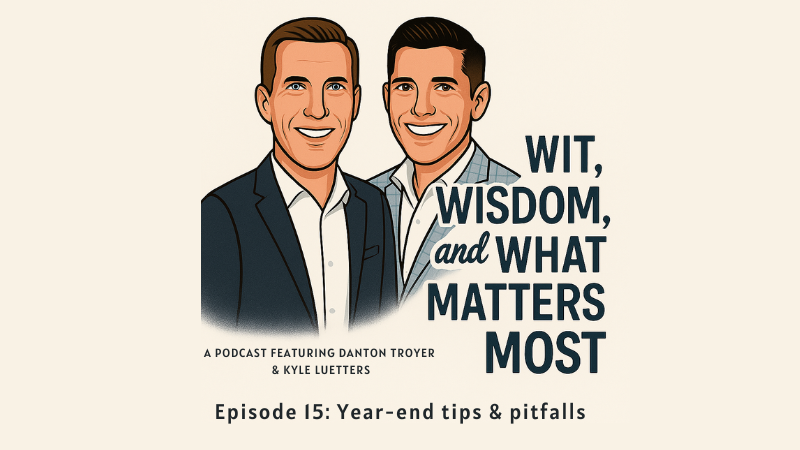
And welcome to another edition of Wit, Wisdom, and What Matters Most. It’s a podcast by Moneta’s Gast Freeman Troyer Racen Team. My name is Kyle Luetters, an advisor on the team.
I am joined by Danton Troyer, one of the partners. And Danton, it is very, very difficult to believe, and I know we say this every year, but it’s very difficult to believe we are at the end of another year; 2025 is coming to an end. And what a year it was, especially in Q1 and Q2.
Danton:
Yeah, it’s kind of crazy to think about all the different things we’ve kind of seen and gone through. From tariff talk to, obviously, leading into a presidential term, and we’re at the end of it. So it’ll be interesting to see.
But we want to talk about some of the year-end planning tips that we typically talk through with clients, but also some of the pitfalls we see in trying to implement those.
Kyle:
100%. And to add a caveat into that, tariffs, Liberation Day trades, and then, by the way, we just really overhauled large bits of the tax code, literally on the 4th of July. I remember reading the summary of what they passed at the pool this summer going, this is going to make for some unique year-end planning opportunities. And we’re going to kind of go through some of those.
So first and foremost, I think we should talk about why it’s crucial to have a plan, why it is crucial to be organized going into this time of year.
Danton:
Yeah, we’ve seen lots of mistakes made, especially heading into year-end because there is a very definite deadline to a lot of these things and it’s December 31st. And so if we’re not getting these things done by that date, they don’t count, they don’t happen. So there is a hard stop in a lot of these.
So being organized to your point and getting started earlier than later are all things that can help not run past that deadline. And once you’re passed, you’re passed.
Kyle:
And I think another thing, too, to back that up as well in this line of thought is 12-31 is the deadline for a lot of this. And if you’ve ever been to the DMV on the last day of the month, you know that it is not the most opportune time to try to get something done. In fact, many of our custodial partners will actually tell us that by about mid-December, anything submitted after a certain date is on a best- efforts basis. They will do their best, but they only have, there’s only so much manpower. There’s only so many hours left in the year in order to get these things done. And then also too, if you think about it from like our perspective as well too, it’s the holiday season and taking a look at the holiday schedule this year, Christmas is on a Thursday. You’re probably going to be reduced manpower the day after and probably the following week. So it really starts to back up when some of these things need to be done into late November, early December. And that’s why the timing and having a plan around this is crucial.
We actually, several members on our team, started this work right after Labor Day of pulling together spreadsheets, figuring out what needed to be done, making sure that we talked to clients well enough in advance because there’s not a lot of people that really want to talk numbers with their financial planner at the Thanksgiving table. They want to talk about it with their brother-in-law. That was a joke.
But anyway, so going through the why and the importance of it a little bit, but we’re just going to go through and break down some things that you should probably be considering. And I’m going to be unashamed and say that this is prime time for tax planning. I mean, it’s year end. Uh, we harvested, uh, hopefully some losses earlier this year when the markets were down. Uh, one of the things – do we need to offset some gains?
Danton:
Yeah. I remember the 2018, we had a market correction right there at year end. And it’s not like you can go place those trades on January 1st and say, I want those losses back for me. You got to get it done by December 31st. So, that was a fun holiday, uh, surprise.
Kyle:
I was late to church on Christmas Eve that day because of that. My wife will never forget that.
Danton:
Yeah, I think it’s burned in everybody’s mind. It was at least around here. We’re all hands on deck trying to get clients that loss, that no one saw it coming. And then all of a sudden the market was down significantly. Um, and then I guess to pour salt on it, it did it again and went down again.
So we were in here like two different days were significant losses in the stock market. So you don’t know when that’s going to come, but you need to be prepared to take advantage, potentially, the tax loss harvesting even at year end. But to your point, that deadline is December 31st.
Kyle:
It has to happen in that year, has to be timestamped as happening in that year to help you out. Now, if you have more losses than you do gains – so basically if you have unused losses – they can roll forward into future years to be able to use.
And that’s why in years such as 2025, the tax loss harvesting that we do is so valuable. We may not utilize the full extent of those losses this year, but they’ll carry forward. And we may need to use them in 2026, 2027, so on and so forth until we use them up.
Speaking of taxes, this is another area that we’ve been spending a lot of time on here recently. It is making sure that withholding – if you’re a W2 employee – is fairly accurate. Or if you’re self-employed or retired, kind of getting some hands around an estimated payment that’s due January 15th, by the way. And, really trying to make sure the tax picture is as true as what we can make it.
Danton:
Yeah, at least here you get, well, two weeks of reprieve. It’s not December 31st, but the reality is, again, you need to be on this almost right now to make sure that you are in; a lot of our clients it’s not as simple as, I’m just getting a salary. There’s other income sources, maybe there’s some executive compensation that was under-withheld as far as taxes go – that’s very common, and just maybe a year-end bonus. I mean, whatever it is, making sure accounting for all these different sources of income, how they’re taxed, and then that you paid enough taxes on those because a lot of times, the payroll is only going to do so much.
Kyle:
Uh, I will say as an employee, I love a year-end bonus. As a tax planner, I love a year-end bonus that’s paid in March of the next year, right? It gives us just a little more flexibility of time, but please don’t hear. I am a huge fan of the year-end bonus, but to Danton’s point, it does bring in an additional element.
And if you’ve been laying the framework, if you’ve been laying the foundation for a lot of this work well in advance, then we get to these pivotal moments of the year and it’s small tweaks. Basically, the entire projections built out and we can go and we can tweak numbers and do a little true up. And sometimes with the withholding or the estimated tax payments, especially on withholding, we can go in and, and kind of mitigate if we need to maybe withhold more, or if we need to send some more back to the paycheck, we can, we have more payroll periods to break that up across because nobody really wants to go into December, realize that they’re going to owe a lot in tax and their last paycheck for the year is dramatically reduced. I will tell you, that is like a hard candy Christmas if I’ve ever seen one.
Other tax moves to consider – using up HSA or not HSA, but FSA funds. So Danton, you kind of want to go through like the difference between HSAs and FSAs as far as it comes to a year-end planning.
Danton:
Yeah, the biggest thing there is that the HSA, we can roll forward and definitely you don’t need to worry about that. And in fact, we’d probably advise you not to spend those dollars.
The FSA is, you know, a whole different animal. You have to get those dollars. I know there’s a little bit of reprieve on that, but for right now, you basically, you do have a deadline to spend those dollars as well. So if you’re not, if you don’t have a handle on that and you didn’t get those dollars out, hopefully we’re not waiting until December 31st to try and get those dollars out, but that would be something you need to be creative with potentially and trying to figure out how we can get those dollars out before year-end, at least to the extent that we can’t roll over.
Kyle:
Yeah. You bring up a very important part about the year-end deadline, and we’ve done some talking on charitable giving. Go check out another episode here in the podcast that discusses that more in depth. But walk us through just a little bit some of the pitfalls that can occur if you do some gifting, specifically like directly to charities, if you don’t get it done soon enough before year-end.
Danton:
Yeah, I was, I guess, shocked myself one year. A client, we were going through their year-end giving and we were assisting them and sending out the checks directly from their account, and they just sent them out probably November. We were shocked to find out come January, some of those checks weren’t cashed.
You would think that with some of these charities, they’re, especially a year in, they’re needing money, which is definitely true. But they also, especially some of these smaller charities, just, they may have the same issues. They may not be staffed-up and they may be processing checks because everybody’s sending checks in right now. They may not get through all of these and that’s going to hurt you from a tax standpoint.
Kyle:
Very much so, because again, it has to occur in the year that you’re intending it to occur. And that ends on December 31st. And to that point as well, backing up with the custodial side of things, if those requests aren’t in soon enough, not only could the charity not cash the check, they also may not get sent out due to a deluge or an overwhelming force or wave of those requests coming in.
Danton, as far as the portfolio goes, year-end, what are some of the things like as clients come in that we’re really kind of talking about from a portfolio perspective as we head towards the end of 2025?
Danton:
Well, I think just cause some of the tried and true conversations of making sure that they’re still comfortable, we’re heading into a new year. It’s a good time to kind of revisit your risk tolerance, make sure you’re still comfortable. Hopefully you are.
And then, we talked about tax loss harvesting, but on the tax side too, I think it’s important to, as an advisor, understanding where your tax bracket’s going to land that year, because that can also implement some of the strategies we want to use here at year end. I mean, maybe it does make sense to take some gains if you’re in a lower tax bracket, again, talking about resetting your cost basis in those positions, that can make sense, as well. And especially hopefully by now we’ve got a pretty good understanding of income and you’re not winning the Christmas day Ameristar winnings and throwing our whole tax strategy off.
But, hopefully now we’ve gotten to the point where we kind of have a pretty good, clear picture of what your tax bracket is going to be, and can make some adjustments from a tax standpoint in the portfolio.
Kyle:
It’s a very wise thing. I know it sounds strange to say we’re thinking about realizing gains, but to Danton’s point, especially in some of those years of retirement, if you’ve retired early before you’ve started taking social security, I would say that is probably the maximum time or the maximum benefit time you have to play with the tax brackets. And so that’s why this work is extremely important.
More work that’s extremely important, too, and we bring this up throughout the year, but really like there’s something about the holidays and being around family that brings this topic close to top of mind is your estate planning. And double checking, do I need to update my beneficiaries? Do I need to get that, either get that estate document work done or get it updated?
It really just seems like this time of the year, people are having a lot of conversations with family and families usually tied into that, so…
Danton:
It depends on who showed up to Thanksgiving and who’s out. We’ve had some interesting Thanksgiving conversations and, you know, that might change the beneficiary designations.
Kyle:
The term I’m writing you out of the will tends to get spoken more often than not. And we’re kind of saying that in jest, but it is a good time for self-reflection.
And on that topic of self-reflection, we are at an end of a year and it’s a good time to review what the goals were for 2025. And did we hit those goals? Did the goals need to change? And did we hit the amended goals?
And then also to talk about setting goals for 2026, if you are contemplating a job change or retirement or something of that nature, it’s a really good time of year to plan for those new goals in 2026.
Danton:
Yeah, that’s our job is sitting down with folks and understanding their goals and what’s most important to them. And we put this front and center more often than not. But especially right now, taking that time to really make sure that you’re not just in the routine of doing the same thing over and over and you say, yeah, I want to retire this and I want to, you know, these are the goals.
But maybe taking a step back and say like, is that still the goal? And the answer hopefully is yes, but I think it’s okay if it’s no. And so I think, you know, having that conversation, you know, maybe internally or maybe with family and making sure that the things that were important are still important.
It’s a good time to kind of take inventory of that.
Kyle:
100%; on the topic of retirement and/or if you’re looking at making a job change, you’re coming to the end of the year. And particularly if you find yourself using a credit card or some type of budget tracking app, December, especially December 31st, you get an entire year’s worth of data to help solve some of these goals going forward into 2026. So, we work with a number of clients that will actually give us a year-end spending summary from their credit card.
And then we’ll add in things like a mortgage and the other things that are not showing up there, but it helps inform and make a better decision, a better goal target inside their financial goal plan. If they are going to contemplate a job shift, because we did have that conversation just the other day, or if someone’s going to retire, it gives them some more trust in the integrity of the number that we’re targeting as we head for the new year.
So, and then also too, planning for major life events is anything in 2026 on the horizon? Weddings, which my goodness.
Danton:
They’re a little pricey these days.
Kyle:
They’re very rich these days. You know, do we need to start kind of setting aside cash for that? And that’s another good part of this year, is we’ve had a good year in the markets. Do we start setting aside some money for big ticket things like weddings? You know, college is maybe on the horizon. And/or retirement, do we need to take some chips off the table just to start building up that income stream in retirement?
So, Danton, as we head for home here, kind of give me some bullet-pointed items. If you’re sitting here and I’m one of your clients, give me like three or four bullet listed things that we should be making sure we knock out in the coming weeks.
Danton:
Yeah, I think the charitable contributions – don’t wait till the last minute as we talked about. That should have already probably happened. And if not, I would not hesitate to potentially follow up with those checks even after they’re sent, just making sure the charity got them and they get cashed on time.
Kyle:
And get a receipt.
Danton:
And get a receipt. So don’t wait till January. I mean, you know, especially if you’re close with that charity, you can make sure that that gets done for yourself.
And, there’s a whole slew of additional things that head up on that December 31st deadline. So, kind of going through your own personal checklist, working with your advisor, going through, just making sure you’ve hit everything. So you can go into the holidays resting assured that you’ve got everything off your financial checklist.
Kyle:
You want to get a lot of these numbers-based things taken care of so that you can truly enjoy and be present during the holiday season instead of worrying about whether or not things are going to get done by the end of the year. And honestly, that’s where someone like us, someone like our team comes into play is to putting a process in place that can be applied across multiple families. And various entities.
So this was fun; I really like it. We did not do an ugly Christmas sweater deal here.
We’re not on video, at least not yet anyway. But this has been another phenomenal year of the podcast. We turned one and now we’re well into what we’re calling season two.
There’ll be even more guests, more conversations, hopefully more myths to debunk as we head into 2026. But I want to just say a special thank you to Danton for being willing to do this. And also, to the folks that have come up to us and said, hey, we listen and we enjoy it. We get something out of it. Just really want to give a shout out and a shot of gratitude to those folks out there.
Danton:
Yeah, the thanks that needs to go out to everybody that’s helped with this podcast is great. And especially guests. We were talking about it, I think, before this. I think we’ve learned a lot just from our guests in different areas. I think our biggest example was learning that there’s a retirement class.
Kyle:
An actual class on retirement that’s not dollars. It’s like mentally and emotionally how to retire.
Danton:
Yeah. I mean, we talk about it all the time. I had no idea there was a class down at SLU.
So, you know listening to one of our clients who’s a business owner talk about his Starlink. And he’s basically running his company from his fishing boat. I have aspirations now. I don’t fish, but, you know, I mean, I’ll learn for that, I think. So, it’s just been great stories throughout the year. And I really just appreciate hearing those stories.
And I’m thankful that we get this opportunity.
Kyle:
A hundred percent. And for the last time in 2025, Wit, Wisdom, and What Matters Most is produced by Moneta’s Gast Freeman Troyer Racen Team, headquartered in St. Louis, Missouri. Until next time, enjoy what matters most and happy holidays.
© 2025 Advisory services offered by Moneta Group Investment Advisors, LLC, 100 South Brentwood Blvd., St. Louis, MO 63105 (“MGIA”), an investment adviser registered with the Securities and Exchange Commission (“SEC”). MGIA is a wholly owned subsidiary of Moneta Group, LLC. Registration as an investment adviser does not imply a certain level of skill or training. This is an advertisement. The information contained herein is for informational purposes only, is not intended to be comprehensive or exclusive, and is based on materials deemed reliable, but the accuracy of which has not been verified. Examples contained herein are for illustrative purposes only based on generic assumptions. Given the dynamic nature of the subject matter and the environment in which this communication was written, the information contained herein is subject to change. This is not an offer to sell or buy securities, nor does it represent any specific recommendation. You should consult with an appropriately credentialed professional before making any financial, investment, tax, or legal decision. Past performance is not indicative of future returns. You cannot invest directly in an index. All investments are subject to a risk of loss. Diversification and strategic asset allocation do not assure profit or protect against loss in declining markets. These materials do not take into consideration your personal circumstances, financial or otherwise. Trademarks and copyrights of materials linked herein are the property of their respective owners.




© 2025 Advisory services offered by Moneta Group Investment Advisors, LLC, 100 South Brentwood Blvd., St. Louis, MO 63105 (“MGIA”), an investment adviser registered with the Securities and Exchange Commission (“SEC”). MGIA is a wholly owned subsidiary of Moneta Group, LLC. Registration as an investment adviser does not imply a certain level of skill or training. This is an advertisement. The information contained herein is for informational purposes only, is not intended to be comprehensive or exclusive, and is based on materials deemed reliable, but the accuracy of which has not been verified. Examples contained herein are for illustrative purposes only based on generic assumptions. Given the dynamic nature of the subject matter and the environment in which this communication was written, the information contained herein is subject to change. This is not an offer to sell or buy securities, nor does it represent any specific recommendation. You should consult with an appropriately credentialed professional before making any financial, investment, tax, or legal decision. Past performance is not indicative of future returns. You cannot invest directly in an index. All investments are subject to a risk of loss. Diversification and strategic asset allocation do not assure profit or protect against loss in declining markets. These materials do not take into consideration your personal circumstances, financial or otherwise. Trademarks and copyrights of materials linked herein are the property of their respective owners.